

Leading With Love - The Virtual Community
The Sessions
During this 12-month curriculum you will be engaging as a leader rooted in your context. That means not only will we be sharing the facilitation of the monthly virtual sessions, but also—vitally—you will be trying out these new practices and leading them in your own contexts and communities. As a cohort, you will then have the opportunity to discuss, reflect on, and learn from your own and each other's experiences in context.
The sessions will take place on the third Tuesday of each month from 6:00 - 8:00 pm (EST). The specific dates and content for the sessions are as follows:
BUILDING COMMUNITY
- May 20, 2025: Building Community Mirror and Window Practice
- June 17, 2025: Building Community Scriptural Reasoning Practice
- July 15, 2025: Building Community Sharing Stories of Experience with Practices in Context
BRIDGING DIVIDES
- August 19, 2025: Bridging Divides Talking Circles Practice
- September 16, 2025: Bridging Divides Futuring Case Study
- October 21, 2025: Bridging Divides Futuring Together to Bridge Divides
PURSUING JUSTICE
- November, 18, 2025: Pursuing Justice The Powers Practice
- December, 16, 2025: Pursuing Justice Transforming Sacred Texts Practice
- January, 20, 2026: Pursuing Justice Sharing Stories of Experiences in Context
HEALING CENTERED LEADERSHIP
- February 10, 2026: Healing Centered Leadership: Mirror Feedback and Coaching Practice
- March 17, 2026: Healing Centered Leadership: Storytelling
- April 21, 2026: Healing Centered Leadership: Case Studies of Leadership Challenges in Context
The attached calendar and sign-up sheet is designed to help you plan how you intend to participate in both the virtual sessions and apply the practices in your context.
While a member of the Auburn Leadership Team will guide key elements of each session – with monthly recaps, framing and check-in, helping folks to dig deeper into the topic for each section, and setting participants up for the following session at the end of the two hours – the bulk of the leadership will be the responsibility of the cohort participants.
A grounding and closing practice are included in each of the areas. These are leadership opportunities where members of the cohort get to practice anchoring the group during the opening and closing of each session.
Unless otherwise indicated all practice sessions will take place in small breakout rooms. This means there should be a dedicated leader for each breakout. The leader acts as the overall facilitator for the given activity and is not a participant. All practice leaders will be provided with detailed instructions on how to lead the practice in advance of the session.

Here you will find worksheets, guides and instructions for the various practices we will engage throughout the program year. These tools are designed to help you lead practices in your context.
Building Community Practices
- Beloved Meditation
- 2X2 Conversations
- Lens to Mirror Practice
- Opening Practices Worksheet
- Scriptural Reasoning Practice
Overall Evaluation
- Context, Impact, Action Worksheet
- Use this sheet to offer feedback to members of your cohort
- Shared Stories of Practice in Context Worksheet
- Use this sheet to record your experience with the practices and tools in your context
Each virtual session will follow a similar structure, intentionally designed to facilitate learning and build community within the cohort.
Each month will include the follow elements:
- Framing, recap - Auburn team led overview of the monthly session and recap of where we have been on our learning journey
- Community check-in - This is our "what's up" moment
- Grounding ritual - Cohort-led opportunity to center our community of practice with resources informed by our religious/spiritual traditions
- Digging Deeper - Auburn team-led opportunity to add depth to the theme and practice of the month, through focused conversation, resource sharing and reflection
- The Practices - cohort-led opportunities to lead practices and methodologies on building community, bridging divides and pursuing justice introduced during the intensive in preparation for sharing them in your context
- Report Back - Highlights and insights from small groups for the good of the whole
- Wrap-Up - Auburn team led "housekeeping," in preparation for upcoming session
- Closing ritual - cohort-facilitated session closing that, like the grounding at the beginning, sends us forth with a word from our traditions.
Learning Objectives
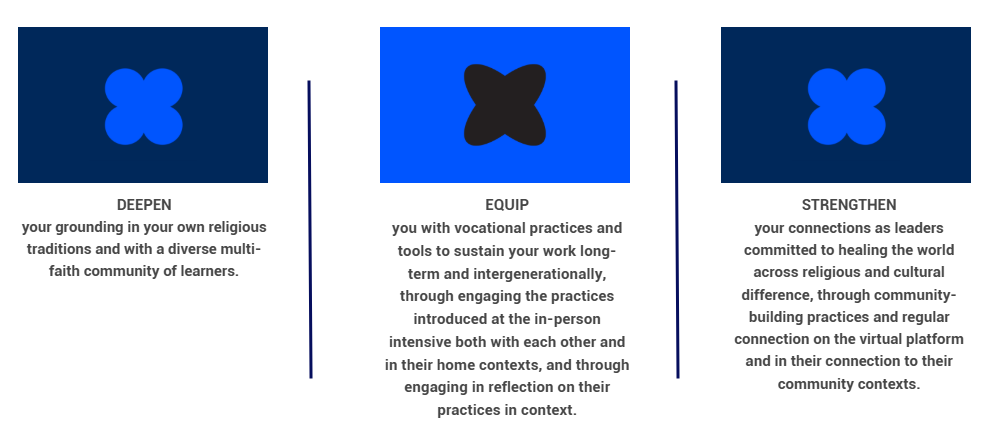
This curriculum will help you...
Course Components
Introduction
-
Welcome and Introduction
 10 MinutesAssignmentLesson Locked
Building Community
-
May Session Building Community from Lens to Mirror and Window Practice
 120 MinutesAssignmentLesson Locked
 -
June Session Building Community Scriptural Reasoning Practice
120 MinutesAssignmentLesson Locked -
July Session Building Community Sharing Stories of Experience of Practices in Context
120 MinutesAssignmentLesson Locked
Bridging Divides
-
August Session Bridging Divides Circle Practice
 120 MinutesAssignmentLesson Locked
 -
September Session Bridging Divides Futuring Case Studies
120 MinutesLesson Locked -
October Session Bridging Divides Futuring Case Studies Part II
 120 MinutesAssignmentLesson Locked
Pursuing Justice
-
November Session Pursuing Justice The Powers Practice
 In this first of three sessions on Pursuing Justice, we will dig deeper into what Walter Wink means by the Powers, the Domination System and Domination Myth, and how to name, unmask, and engage the Powers; engage in cohort-led practice; and consider how this practice can be applied in your context.120 MinutesAssignmentLesson Locked
 -
December Session Pursuing Justice Transforming Sacred Text
120 MinutesAssignmentLesson Locked -
January Session Pursuing Justice Sharing Stories of Practices in Context
120 MinutesAssignmentLesson Locked
Heal The World
-
Healing Centered Leadership I: Mirror Observation and Feedback
Framing and Check-In: Auburn staff
Grounding: cohort facilitator
Digging Deeper: Auburn's Practice of Mirror Observation and Coaching
Why This Practice?
- Healing centered leadership is both essential to and grows from our work to build community, bridge divides, and pursue justice through narrative change.
- Coaching can harm or heal depending how it is done.
- Auburn's approach to Mirror Observation and Coaching is intended to be healing centered, done in the context of a community, attending to the dynamics of doing so across differences, and looking to write the story of our best selves in how we offer, respond to, and grow from it.
- What does it mean to listen for the sacred in people? To look for healing within and/or between? What is the gift and challenge of a conversation that calls us to hold the personnel and pastoral/rabbinic/irshad leadership roles together?
- Not easy but important to give and gain feedback across differences, especially when it is about something people care about deeply.
- Practice that can be done with compassion and intent to stay in relationship with the person.
Research on Feedback
- Too often we give or receive feedback in ways that triggers our fright-flight-freeze response. We fear failure.
- There are steps to framing feedback that helps people stay in our prefrontal cortex—the part of our brain where we can be self-reflective and adjust and grow.
- Specific and Observable Feedback is most helpful:
- Not "every time" statements ("Every time we xxx you always xxxx)
- Not character statements ("You are stubborn" "passive" "domineering")
- Specific examples of skills and capacities reinforce behavior and action; generic compliments feedthe ego but don't help the recipient grow.
- Taking notes helps keep it specific, focused on what was observable, and ensures that the feedback when it is given won't have become vague.
Mirror Coaching recognizes that when people are in the moment, they are usually leading or interacting in way that they think is their best, often unaware of how it is really impacting others.This isn't a character flaw but a natural limit to how we can perceive ourselves when we are in the moment. The gift of Mirror Coaching is that it holds up an objective mirror of one's actions in a context and the observable impact on the group or the clearly identified impact on the observer.
Mirror Card Observations
Use the Framework: Context, Action, Impact
Examples: What's Not Working? How Would You Reframe?
Coaching
Asking Permission, Sharing Observation, Asking "Is that what you intended?" and Listening
Small Group Practice
1. An example of feedback you received that was helpful. What made it helpful to you? How did it impact your leadership after receiving it?
2. An example of feedback you received that was unhelpful
Small groups will discuss the four feedback examples you identified in advance of this session, and ways to revisit them using Mirror Feedback and Coaching insights
Wrap Up: Auburn Staff
Closing: Cohort Facilitator
10 MinutesAssignmentLesson Locked -
March Session Heal the World Theopoetic Practice
 120 MinutesAssignmentLesson Locked
 -
April Session Heal the World Celebration
120 MinutesAssignmentLesson Locked
Features and Benefits
The 12-month virtual curriculum provides a sustained learning experience while cohort members are rooted in their community contexts. This enables participants to take learning from the Intensive and practice it in context, with ongoing opportunities for reflection, discussion, and support as you build your leadership skills.
How This Equips Faith Leaders
Auburn's Emerging Leaders Curriculum begins with an in-person multi-day Intensive followed by 12 monthly virtual sessions. The virtual curriculum is designed to deepen and extend learning from the intensive, provide opportunities for cohort members to learn through facilitating practices with each other, and discuss and reflect on experiences of using the practices in community contexts. Through the year-long curriculum, Emerging Leader cohorts deepen their grounding in faith traditions and a multifaith community of learners; become better equipped with vocational practices and tools to sustain their work long-term and intergenerationally, and connect with other leaders who are committed to healing the world with peers across religious and cultural difference.
Auburn Emerging Leaders Program Spring '25
Taught by Auburn Faculty
This 12-month virtual journey strengthens emerging faith leaders to integrate love, justice, and community-building within their ministry contexts—bridging divides through spiritually grounded leadership and reflective practice.
Meet Your Instructor,
Auburn Faculty
No bio available for this instructor.