
ASSIGNMENT 1| FORUM QUESTION |CREATION
October 21, 2025 5:48 AM
ASSIGNMENT 1| FORUM QUESTION |CREATION
Please respond to the following prompt: Where do you fall on this question: "Are human beings more valuable than other beings (animals or plants) in our world?"
Discussion (24)
Forum – Are human beings more valuable than other beings (animals or plants) in our world?
I do not believe human beings are more valuable than other beings, but we behave as if we are. We justify this because we are beings with consciousness and reflection abilities making us distinguished from nature. And because we have made that distinction this is the reasoning for claiming dominance, positioning humans against everything else, and one another. US vs THEM, ME vs YOU.
This reflection makes me think ah ha, perhaps this is the origin of othering, starting with creation. Also, I wonder maybe this dominance was once a means of survival that at some point became behavior out of habit that was never challenged or questioned. I believe there are individuals who consciously step out of this pattern, but most do not due to autopilot. Real harmony would require rethinking our relationship with the earth and creation as stressed in the readings, however centuries of practice and indoctrination make this shift difficult and perhaps impossible.
Shiree, your insight/question about othering beginning with creation stopped me in my tracks. What a provocative thought. Going to take some time to reflect on that.
Shiree: I agree with you that "perhaps this is the origin of othering, starting with creation." I would venture to say that there are many Christians today who (still) believe in some level/degree of dominionism, that is, that the Divine has "given" creation to human beings. What we often forget is that this planet (and the universe, of course) has been here long before humans and will be here long after we are gone.
The history of Christianity is punctuated (from its beginnings) with reform movements and St. Francis of Assisi and the larger mendicant movement was one of the most important reforms in medieval European Christianity. As we've read, Francis's attitude to creation was remarkable for his (and perhaps our!) day. In the past 50 years or the fields of "creation theology," "ecotheologies," and scores of Indigenous Christian theologies have made the invitation to a more sustainable stewardship of the earth a core part of their reflections on what it means to be a follower of Jesus.
"Are human beings more valuable than other beings (animals or plants) in our world?"
I think there are two ways to answer this. One, looking at the big picture, the answer is no. All the elements of creation, including human beings, interact to maintain a precarious balance of Life. Human beings rely on the health of the planet for their survival. Therefore, all of creation is equally valuable.
However, when confronted with a moral situation, it’s not so simple. For instance, if there is a person and a dog in a burning building, who do we feel morally obligated to save first? Why? Is there not a higher value placed on a human life? It’s complicated.
I agree its complicated, Judy, particularly when you pose the burning building question. Is it your dog?
I think that balance of life eroded when the sacred of nature was removed as noted in White's essay. Permission and reverence was no longer and instead man focused on gain for his immediate benefit. one decision after another in a long chain of destruction.
Thank you, Judy, for stating this so succinctly: we do (or at least most of us do, I think) place a higher value on human life when it comes to a moral choice between saving a human being's life vs. another life form. What I am reflecting upon as I reread your post is that a theology rooted in a reverence for all creation doesn't mean that we eliminate our moral framework about prioritizing human life, but it may well mean that we respect plants, animals, non-sentient and sentient beings, etc., as all intricately a part of the web of life. Yes, as you say, this is a point of view in which "all of creation is equally valuable."
Clark Kellogg
Christian History, Prof. Bernard Schlager, Ph. D.
Lesson 3, Assignment 1, December 10, 2025
Are human beings more valuable than other beings (animals or plants) in our world?
A hard no. While it may not be a popular opinion, I would now say human beings are becoming less valuable than animals and plants in our world. I base this on a simple metric: who/what is more destructive to the life support systems of planet earth? We humans are the only species I know that destroys its own habitat, willingly forsaking the future of our descendants and our planet.
I was struck by Lynn White’s observation that, “Our daily habits of action, for example, are dominated by an implicit faith in perpetual progress… It is rooted in, and is indefensible apart from, Judeo-Christion teleology.” It is this relentless quest for “more” instead of “enough” that has created an alarming crisis for all life forms on earth.
The readings were, for me, deeply illuminating. Each comes from different perspectives and different eras, yet all three imply or explicitly call for respect, humility, and interdependence with nature, spirit, and the earth. White’s explanation of Christianity’s influence humans separating themselves from nature rang out to me. “By destroying pagan animism,” he wrote, “Christianity made it possible to exploit nature in a mood of indifference to the feelings of natural objects.”
A mood of indifference…
My mother met her life-long best friend, Lukie, when she was in 2nd grade. Lukie’s family had a small cabin in the High Sierra mountains. Each summer, my mom would move with them to Huntington Lake until school restarted in the fall. The two best friends grew up, got married, had kids, and kept going to the mountains every year. My first summer in the High Sierras began when I was six weeks old. I kept going to the mountains every year. Over time in the mountains, I learned reverence for all life forms mostly from Native people of the Miwok and Mono tribes. Their traditional seasonal movement of hunting and gathering in the mountains had long been disrupted but the knowledge was largely intact and sometimes they taught me. That is a much longer story - a love story - but it is why St. Francis’ “Canticle of Brother Sun and Sister Moon,” seems like common sense to me. It is also why I fervently believe that human beings are no more valuable than the animals, plants, rivers, and spirit that sustains all forms of life on earth.
ohhh less valuable than plants and animals. I felt that, and I can see it. Love the share about your mom and her friend. a beautiful journey.
Clark: in my more pessimistic (realistic?) moments I wonder if the earth (Gaia) will at some point throw up her hands and decide/realize that the human species is simply not sustainable, that the earth can no longer accommodate beings who live and act as if creation were an infinitely consumable resource that need not be respected and replinished through a more sane way of living on this planet.
Thank you for including your childhood memories of being in the High Sierras. I, too, have very early memories of precious time in "nature" (or "the woods" as we called it). Every summer my parents, my 7 siblings and I would spend time in Door County, Wisconsin. In the 1960s it still seemed (at least to a child) that it was "pristine" in some senses. And time there and with adults who respected the setting and appreciated the wisdom of striving for a light footprint on the land helped ot instill in me from early on a respect for the creation of which we are a part -- but only a part.
I think that what Francis of Assisi (and many, many others) help me to understand is that there are ways in live as a Christian who places care/respect/love for creation at the very center of one's spirituality. Many other religious traditions, of course, also hold a deep respect for nature as made up of many beings. AND I also find meaning in understanding the planet as an organism unto herself/itself.
Are human beings more valuable than other beings in our world?
My gut answer is no. Not only are we humans not more valuable, but our behavior, our goals, our “morals” are totally out of whack with the ecosystem. Many of us don’t even think of ourselves as being part of a system that includes ants, streams, trees, newts. Think of how some people mock the city of Berkeley (Bezerkley) because they close down South Park Drive in the winter for newt crossing.
For me, in the grand scheme, I believe that we humans need to see of ourselves as part of a planet-wide web or ecosystem, and consider how we can cooperate for the benefit of all living things. But even in this system there will be conflicts, and inevitably losers and winners. Who gets to decide what species eats another (a kind of domination) and whose habitat gets to survive? We humans have had our thumb on the scale for so long it’s hard to imagine a world in which our effect on the system is minimized.
It also gets more complicated when we get to the level of individual humans we know, or even empathize with. A number of stately redwood trees have come down in my Berkeley neighborhood recently because they threaten the houses of my neighbors. Redwoods have always fallen in the woods, where they become nurse logs and nurture future growth. Many of the redwoods in my neighborhood likely started their lives in a different environment, both in terms of what was around them (not houses) and also in terms of increased environmental events (wind and storms caused by climate change) that make them more vulnerable. But in this situation, am I going to advocate for my neighbors to leave so the trees can do their thing? Because they were here first? Does this mean that the humans are more valuable?
Or does leveling out the value between humans and the rest of creation mean that we start to have different conversations about who and what we’re living alongside? Those conversations could be a start to living more in balance with the natural world. But on a global level the forces of domination, capitalism, extraction continue at a devastating pace and even though we know what it’s doing to the planet, we’re unable to quell our greed.
Katherine: yes, I too, "believe that we humans need to see of ourselves as part of a planet-wide web or ecosystem, and consider how we can cooperate for the benefit of all living things." However, as you not, there are losers/winners (or perhaps those that survive and those that perish -- either as individuals or, heartbreakingly, as species).
Life is full, as we know, of choices that have to be made and sometimes that leads us to remove a tree or animal(s) from a particular environment for the greater benefit of the environment and/or for humans. What we have so often in history, of course, are situations in which, as you say, we "humans have had our thumb on the scale for so long it’s hard to imagine a world in which our effect on the system is minimized."
What theologies of creation call us to are living into a view of creation/nature/the cosmos as both gift and our home, a home which we share with so many other beings.
I'm drawn to listen to stories of creation/the origins of the earth and all beings from various human cultures because so many of them are steeped in an understand that we humans can and should be in right relation with creation. To mistreat creation is (in traditional Christian terminology) sin and we cannot be in right relationship with the Divine or ourselves when we mistreat the womb from which we come.
Rev. CJ
Christian History & Social Change, Week 3
Assignment 1, Forum Question: Creation & Value
13 December 2025
"Are human beings more valuable than other beings (animals or plants) in our world?"
What makes us assign value to anything or anyone?
To do so—at least as I immediately think of valuation—requires us to see the world through a lens of coloniality, white supremacy, capitalism, and other worldviews that place relative value on all things.
Growing up in the American South, I know that European colonizers certainly came to Turtle Island with this mindset of “valuing” everything here, including the peoples who cared for the land and those they stole from Africa. They assigned value to those living in other parts of the world as well, and always viewed them as less valuable than the familiar and the “civilized.”
Classically, Buddhism—with its roots in other Indic/Dharmic religions—has seen human form as the “best” or perhaps the most auspicious form one could inhabit, because it is the one in which one can become enlightened, however there are many tales of beings practicing the Buddha-Way in other forms such as nature’s spirits and various animals. The bhavacakra (“wheel/circle of life”, depicted below/url) depicts the various forms of transmigration through the six realms, some are considered karmic births of punishment and others births of reward. I suppose we could say that some are more “valuable” than others, but I don’t think that is the intention of Buddhist teachings across all lineages with which I am familiar, rather they help us understand the interbeing of all existence.
Some modern capitalist Buddhists might value human life more than that of animals, plants, or minerals & land (non-sentient life is still life), but our human lives cannot be sustained without the lives of so many other beings, so to place a relative value on life based on states of existence is foolish. No life is more “valuable” than any other, as each one interpenetrates the lives of all other beings, and therefore one cannot exist without the other.
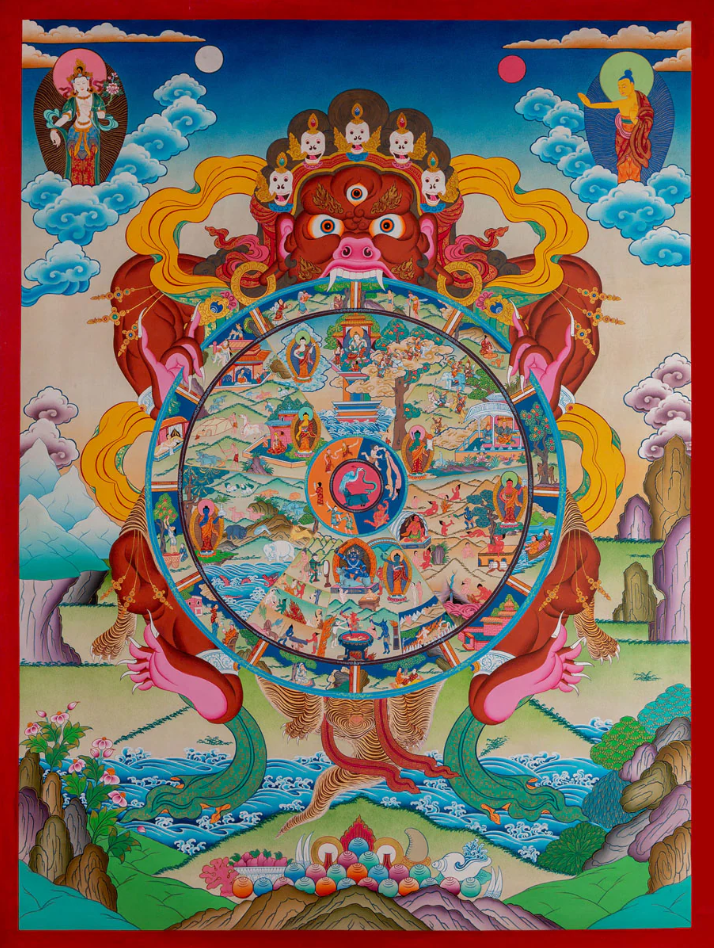
https://luckythanka.com/cdn/shop/products/LA04205.jpg?v=1569294333&width=903
Thank you, Rev CJ, for including Thangka at the end of your post!
And I appreciate your mention of the concept of "interbeing," a term that Thich Nhat Hanh may have coined, I think. Increasingly Christian theologies are taking up this concept and linking it to such traditional concepts as "the Great Chain of Being," which is often used to explain the 13th-century Dominican theologian Thomas Aquinas who spoke of all being as emanating (or proceeding forth) from God.
Your comments on European settler/colonial culture in North America has me thinking about some Christian theologians who (especially in the era of Europena colonization from the 15th centuries on) who propounded the view that land not used in ways that Europeans understood to be "fruitful" or "useful" could be taken (stolen) from Indigenous peoples.
My sense and hope is that many forms of Buddhism that are taking root in the West are leading to new and different ways of understanding the inter-relationship of all creation because there is in Christian history (and in the present) a deep appreciation for nature/creation/the earth that can be drawn upon to repair our world -- and to repair ourselves and our often-alienated relationship with the rest of creation.
Amanda Weaver
Christian History & Social Change
Lesson 3: Reflection
Humans are not more valuable than other beings on this planet. However, we’re generally the most problematic. When we neglect the duty of care we have to the world and instead exploit it for our own means, we cause no end of trouble. We’ve used theology to justify uncoupling the need for mercy and justice from the “natural” world, and now we’re suffering the consequences of climate change, species loss, and so much more. The way we live puts us in direct conflict with the world instead of living in harmony with it.
Amanda: yes, "living in harmony" with the world/creation is how I read the creation stories in the Book of Genesis. For too long we (humans in many different eras and places) have had an extractive view toward our home/planet: take and take and take. I remember coming across the book "The Giving Tree" when our children were little. My takeaway from that story was one of deep sadness. While I may be missing other parts /messages of that story, the tree gave and gave and gave to a human being who seemed to be insatiable and also unaware of the life/the being of the tree, as much a part of creation as the boy/man...
M. Cross
Christian History
&Social Change
Bernard Schlager, PhD
Lesson 3, Assignment 1
Forum Question - Creation
"Are human beings more valuable than other beings (animals or plants) in our world?"
How could we possibly be more valuable than other beings when we are totally dependent upon this earth to sustain our existence? Rather than being more valuable, we are more responsible for taking care of it so that the environment can continue to nourish future generations.
I see animals and plants as real beings. Though they don't communicate with us as we define communication, they live and die as dictated by God, with clarity of their function and purpose. There is no wavering or questioning, no confusion. Just life as God designed.
I love your phrase here, Mary Catherine: rather than "being more valuable, we are more responsible for taking care of it so that the environment can continue to nourish future generations."
As I read through this Forum postings I'm thinking that I could have created a more nuanced question for this week. When I wrote the Forum question I had recently been reading about the continuing destruction of the Amazon Forest, the "lungs" of the planet that provide oxygen (among many, many other benefits) to those creatures (like us) who need to breathe!
My hope is that when we humans value the "being," the existence of all our companions on this planet -- then we will respond to God's call to share in God's design for the world God created, blessed, and asked humans to steward with responsibility and -- most of all -- with love.
Ogundipe
Week 3 - Reflection
Are human beings more valuable than other beings (animals or plants) in our world?
Theoretically, it is true that I don't believe that human beings are more important than animals or plants, but my behavior indicates that if this is indeed a position that I hold truly, I at best hold it hypocritically.
For instance, humans engage in so many actions that degrade the habitat of animals (cutting down trees to build roads and highways, use of plastic, gas, electricity, etc.), I am guilty of.
It is hard to shake an anthropocentric view of the world.
For many years I was ignorant that this was even my view.
Awareness is the first step, and now I hope to move in the direction of greater alignment in actions with the notion, that humans are not more important than animals and plants.
Well said, Victor: "awareness is the first step." So many of us (I included) was raised in a worldview that placed human thriving over the thriving of our planet and all of its many beings, including rocks and minerals, etc. Perhaps what many Indigneous theologies, a Franciscan view of the creation, and Lynn White's article remind us/call us to live into is a way of living on this planet that prioritizes the thrival of ALL creation because we are intimately tied to everything/everyone/every being...
Deborah Anderson
Christian History and Social Change
Bernard Schlager, PhD
Lesson 3, Assignment 1
Forum Question - Creation
Are human beings more valuable than other beings (animals or plants) in our world?
No—emphatically not. Human beings are not more valuable than other beings. We are one part of a vast, interdependent web of life. Animals, plants, ecosystems, and humans each have intrinsic worth, not because of their usefulness to us, but because all of creation is called into being by God, declared good held in God’s love. When humans place themselves above the rest of creation, the result is exploitation, environmental destruction, and broken relationships.
And yet, being human carries a particular responsibility. In Jesus, God takes on flesh and steps fully into the created world, blessing bodies, land, water, and ordinary life. That incarnational love doesn’t lift humans above creation; it ties us more deeply to it. Our ability to choose and reflect means we are called to live gently, to tend rather than take, and to act as kin and caretakers among our fellow creatures—not masters over them.
Leonard Bailey
Christian History and Social Change
What is Creation and Who Am I in this Creation?
12/10/25
Forum Post: Are Human Beings More Valuable Than Other Beings in Our World?
To be real, this question has had me going back and forth. Growing up, I was always taught—especially in church—that humans are made in God’s image, which makes us “above” the rest of creation. That belief kind of just sat in the background of everything I did. But as I’ve gotten older, studied different spiritual perspectives, and looked at how much harm we’ve caused to the earth and animals, I’ve started to question that hierarchy.
I don’t think being human makes us more valuable than other beings—I think it makes us more responsible. If anything, our intelligence and ability to reflect on our actions means we should be the ones protecting and preserving life, not dominating it. Plants, animals, and even the environment have value in themselves, not just in how they serve us.
If you look at Indigenous teachings you'll see a way of honoring all of creation as sacred and interconnected. That hits different. It makes me think maybe we’ve gotten it wrong by putting ourselves on top of everything.
So no, I don’t think humans are more valuable than other beings. I think our value is tied to how well we care for the rest of creation—and right now, we’ve got some work to do.
"This resistance is grounded in the very structure of the brain."
In Seminary, one of my professors demonstrated how the brain actually learns something. He drew a straight line on the board with "A" on one side and "B" on another. He informed us that we like to think that this is how the brain learns, but this is incorrect. The best way to understand how the brain works, according to him, was like a slightly stretched out rotary phone cord, with "A" on one end and "B" on the other.
As the brain absorbs and interprets new information, it puts it through different tests to see how the learning fits with previous learning and where it doesn't. As the thought begins to be incorporated, (seen as ascending one of the loops), there is quick acceptance and eager implementation for it. As the thought progresses, it then reaches its zenith and then the push-back arrives upon the thought and the brain begins to reject it. As the thought then descends it begins to see where the thought fits and where it doesn't and then it continues on to the next loop. At each stage of the loops of thought implementation, it is never a straight line, and may look like it is regressing, but it's trajectory is always forwards, in some form or fashion.
As I read this article from Wink, I was reminded of that teaching. 2 parts stood out to me, and the one was the resolution that whatever task you were going to do, you were going to do it, even if there was pushback and resistance. That if the exercise of implementing the thought, the theological examination, in such a way that it becomes real and actionable, is not received well, then let that come out after the fact, not during it.
The other point that leapt out to me was the idea that if someone is resisting the exercise, then ask them "try it as an experiment. Don't make it optional." That allows the person to engage the exercise/concept/task and encourages community engagement for those to whom the exercise might be beneficial even if it is not for all.
There are elements of Paint the Picture that I think can be reworked in using Lego's. I found examples of this on YouTube and have observed that many children, and many adults, enjoy building with Lego's. I think that there is a place for me to use this idea in worship, or in some fashion of spiritual engagement that may be surprising.
Write a dialogue - This I will use, in a form. I think that I will invite people to write questions, as though they were going to interview a character within scripture. I think of the woman who touched the robe of Jesus...and encourage the people to wonder what questions they might ask her if they were given a chance.
Gestalt Characters - This I utilize in message creation and delivery often. I walk around the worship space and indicate a character while standing in one place. Then moving to another, I indicate another character, and so on as necessary. Usually not more than 3 or 4. As I engage the scripture, I often encourage people to wonder what they would feel if they were one of the characters, and then I go to that space, and offer some of the thoughts/questions/observations I would have if I were that character.
I know that there are elements of other suggestions, like make up skits, move to music, repeat holy sentences that I utilize in part, but with what was listed in the writings, I feel the 3 I have identified, I think, will be the most effective for the communities I serve. And, I recognize that I will need to repeat them in different ways for the scripture to become infused with the person. As my professor indicated, these will not be one time applications; they will take time and repetition for them to be effective.
Many spiritual traditions teach that the earth is sacred. Some describe creation as the first revelation of the Divine. Before sacred books were written, mountains stood as testimonies. Rivers sang hymns. Trees stretched upward in silent prayer. The natural world is not merely a resource to consume; it is a living expression of beauty, wisdom, and interconnectedness. Humanity loses something spiritual when it forgets this truth.
I have seen the consequences of forgetting. Forests cleared without restoration. Waters poisoned for profit. Animals hunted beyond necessity. Air thickened with smoke and chemicals. The earth groans under the pressure of human excess. While you have developed remarkable technologies and civilizations, many of your systems are built on extraction rather than harmony. Too often, power is measured by domination instead of stewardship.
Yet I do not write to condemn humanity entirely. I have also witnessed your compassion. I have seen humans protect forests from destruction, rescue injured animals, plant gardens in forgotten neighborhoods, and stand together to defend the earth. I have watched children marvel at the sight of towering trees and instinctively understand wonder better than many adults. Within humanity remains the capacity to heal what has been harmed.
From my perspective, the spiritual purpose of creation is relationship. No living being exists alone. The rivers depend on the forests. The forests depend on the soil. Animals depend on plants. Humanity depends on every part of this delicate balance even when it pretends otherwise. This interconnectedness reflects a sacred truth: life was never designed to thrive through isolation or exploitation. Creation flourishes through mutual care.
If humanity truly sees itself as possessing greater intelligence or moral awareness than other living beings, then let that awareness become responsibility rather than entitlement. Greater power should produce greater compassion. To care for creation is not weakness; it is wisdom. It is recognizing that destruction of the earth is ultimately destruction of yourselves.
I ask you to slow down long enough to hear the world around you again. Listen to the wind moving through trees. Sit beside rivers without trying to conquer them. Protect ecosystems not simply because they are useful, but because they possess inherent worth. Teach future generations that the earth is not disposable. Let your spirituality include not only concern for human souls, but concern for the living world that sustains those souls.
One day, humanity will understand that survival alone is not enough. You are called to live with reverence. The measure of a civilization is not only found in wealth, architecture, or innovation, but in how gently it treats the fragile web of life entrusted to its care.
I remain standing, rooted in patience, hoping humanity chooses renewal over destruction. The earth still offers beauty. The forests still breathe. The rivers still flow. There is still time to remember that you belong to creation rather than rule over it.
With enduring hope,
An Ancient Redwood Tree