
Assignment | Definitions on Colonialism and Decolonial Thought
April 28, 2025 9:58 PM
Assignment | Reflective Questions
Before moving on to the project assignment for this lesson, take a few minutes in reflection, then answer the following questions...
- What is Colonialism?
- What is Coloniality?
- What is Colonial Alienation?
- What is the importance of Decolonialization?
Discussion (25)
Katherine Whitney
October 31
Assignment 1 - Contextual Thinking: Decolonization
When we stop and take a considered look around us the lingering effects of colonization are everywhere. In my country of origin - the United States - colonial powers of Britain and Spain predominately took over the territory, exploited its economic riches, dominated the Indigenous populations (killing off whole populations through both overt violence and exposure to pernicious illnesses) and erased their cultures.
We see the enduring effects of this colonialization—the colonialiality—everywhere. Can Big Ears National Monument, a land sacred to Indigenous peoples, be valued by today’s United States government as anything other than a place for extracting resources? There are so many examples of push and pull, and sometimes we see what looks like progress for Indigenous cultures. But these wins are under continued threat from an enduring colonizing mindset. A complete re-evaluation, along the lines of Muldoon Torres, has not occurred.
With this consistent and continual power imbalance it’s not surprising the alienation of the colonized people is not surprising. In the example of Bears Ears—and recognizing the ubiquitous examples all around us—when the political power that holds the purse sees your land not as sacred but as a cash reserve, it is hard not to be demoralized and alienated. A people alienated by colonization face psychological, cultural, linguistic dominance and are made to feel inferior.
Decolonization aims to dismantle these systems, recognizing the value of Indigenous systems of knowledge and allowing a reclaiming of autonomy, agency, epistemology and power. Decolonization breaks down the damaging, hierarchical structures of colonialism, completely re-evaluating how we understand knowledge, culture and power. Ultimately it’s not enough to invite the diverse voices to the table if we are not going to value their perspectives. Keeping with the same example I’ve raised up: we have heard from the Indigenous people how important Bears Ears is to their culture, but is this valued in the same way by those in political power? We really have to fully transform our systems and structures in order to dismantle the legacies of colonialism.
Katherine,
Your phrase, "consistent and continual power imbalance" struck me. It describes the relentlessness of the power imbalances with no relief.
Colonialism is a system where a powerful nation takes control of a less powerful region
- Colonialism is the Zionist entity continually displacing and enacting genocide on the peoples of Palestine since well before 1948. Colonialism hides behind "complexity" as it unfolds, but is much clearly identifiable in hindsight.
Coloniality refers to the enduring patterns of power control & domination that persist even after formal colonialism has ‘ended’… highlights how colonialism reshapes not just politics and economics, but also knowledge systems, structures and social structures… persists through institutions…
- Coloniality is patriarchy, queer- and transantagonism, immigration and customs enforcement & border patrol, policing & incarceration. Coloniality is believing that all religions center God and ones that don't are not religion. Coloniality is labeling enemies as "terrorists" and allies as "freedom fighters."
Colonial Alienation refers to the psychological, emotional, and cultural disconnection experienced by those who are subjected to colonial rule.
- Colonial alienation is the shame I feel at being Appalachian. It's what I feel when I hear the words "redneck" or "hillbilly," what I feel when someone calls the bluegrass music of my ancestors--songs about owing our souls to mining company stores and dying young from black lung--debasing this music as "provincial" or "podunk."
What is the importance of Decolonization?
- Decolonization allows us to see one another authentically and truly work toward equity and mutual liberation, rather than adopting "the tools of the master"--as put by Audre Lorde--and repeating the same terrors over and over again. Nelson Maldonado-Torres explains that decolonization goes beyond leftist politics and goes much deeper into the roots of inequality and injustice; it allows us to deeply query our assumptions about what is human, what is reason, what is justice, and dream new ways of being into life while reviving old and more just ways that might have long been hidden.
CJ,
Your description of your shame at being Appalachian was disarming and powerful to me. Thanks for sharing that.
Hi CJ, I respect your perspective and point of view, because it feels authentic and from the heart. Thank you!
To be able to "go beyond all politics to deeply query what is human, what is reason, what is justice and dream new ways of being into life..." What a gift that could be and something I hope we are onto here in this work we're doing together. Thank you CJ.
What is Colonialism?
A system that allows for the acquisition of land, exploitation of resources and political domination of one people by another. In ancient history colonialism was specifically the geopolitical domination of a known people over another. Modern colonialism includes the myth of “discovering” lands and dehumanizing the indigenous people of those lands.
What is Coloniality?
The internal colonization of a people that have been colonized. It is when a people who have been dominated believe themselves to be less than, less human, less desirable, less deserving.
What is Colonial Alienation?
The disconnection of a people from their own land, culture and identity. Pressure to assimilate into the dominate culture, but ultimately unable to be fully do so. Remaining unaccepted, less than.
What is the importance of Decolonialization?
It counters the metaphysical catastrophe of colonialism and the coloniality that stems from it. Decolonization brings about a world that thrives on diversity. All benefit.
Let's build that "world that thrives on diversity where all benefit." Count me in, Judy!
Judy, your statement "Decolonization brings about a world that thrives on diversity. All benefit" is really powerful. It is true, we all benefit from the beauty of diversity.
I agree! In these times, it is a deep relief to hear discussion of a "world that thrives on diversity". Thank you!
If we could all see the "metaphysical catastrophe" that is colonialism where might we be? How to get the colonizers to loosen their grip on "more and more" and see that indeed all can benefit?
Clark Kellogg
Contextual Thinking: Decolonization
Assignment 1, October 31, 2025
I am a white American man of privilege. I was born in the Central Valley of California, and the first years of my life took place in and around my relative’s farms and ranches (on land taken from the Mono and the Yokuts people). I loved picking fruit, didn’t love branding cattle, but loved life on these farms. That is until my uncles told me picking fruit and feeding cows was “below” me. It was done by Mexican farm workers.
Thankfully, my family moved to San Francisco when I was eight years old. There, I went to school with all kinds of people who were “below” me and “above” me in the stratified and categorized colonial structures of power, culture, privilege, and knowledge. We didn’t have much money, but we were white. I was young but I wasn’t blind. I recognized coloniality (although I didn’t know the word) in the schools I attended (we had tracked groups in my junior high school which largely segregated us by race). The rental community where I lived only rented to white people. My parents were not well educated and did little to learn, challenge, or change the status quo.
Colonialism’s impact on California from the Spanish, Russian, and Northern Europeans was tucked under the umbrella of “manifest destiny,” which neatly cleaned up the history books and the cultural narrative of California – particularly in the 1950s and 60s when I was growing up.
The legacy of colonialism has taken root, grown, and spread. Coloniality is woven into the fabric of American life. My California public education rationalized the marginalization of everyone who was not a white Christian. These power structures have created the massive inequalities in education, healthcare, economics and culture.
The resulting Cultural alienation directly harms to people of color and indirect creates a loss for white people. It took the Civil Rights movement, the Black Panthers, the United Farm Workers, the Vietnam war, and the Black Lives Matter moment for me to begin to understand coloniality and cultural alienation from an empathetic point of view.
The work of decolonization in contemporary America is as critical as it is daunting. I see the Trump administration and the movement that support it as doubling down on resisting decolonization in any form. For me, the work of dismantling the colonial structures of greed, exploitation, regulation, and fear, is essential of our country is to survive as a democracy that can work toward a pluralistic society.
This struggle to “defend our humanity until the very end,” as Nelson Maldonado-Torres said, is necessary and is a great loosening of the yolk that has done such harm to generations of indigenous people, Black and Brown people, Asian and Pacific Island people. A white man of privilege like me, will also benefit from dismantling and recreating America so that we can all live in the glow of so many ways of living in community and interdependence. This will not happen in what’s left of my time on earth, but that doesn’t diminish for me its urgency and importance.
Hi Clark, "Thank you" for being honest and transparent in your sharing this week. It's rare I experience that from "a white American man of privilege". I appreciate your contributions to this cohort and forum.
M. Cross
Contextual Thinking
Dr. Alexandra
Rosado-Román
Lesson 1A
Colonialism: A system where a more powerful nation takes control of a less powerful nation.
Colonality: Refers to the endurin pattern of control even after formal colonalism has ended
Colonial Alienation: Refers to psychological, emotional, and cultural disconnection experienced by those subjected to colonial rule
Delcolonizaton: The process of dismantling systems, structures, and ideologies to restore autonomy and identity to the formal colonized communities.
Decolonialization reconnects the colonized with their origins. It is also about redistributing power and wealth. Decolonization is also important for the radical transformation of ways we think and interact.
Ken Glass
October 31
Assignment 1 - Contextual Thinking: Decolonization
1. What is Colonialism?
Colonialism is the practice of domination where one country or power acquires and maintains full or partial political control over another country or territory and its people. By exploiting its people and the territory's resources (like raw materials or labor) for its own selfish economic benefit and gain.
2. What is Coloniality?
Coloniality refers to the enduring patterns of power that emerged from European colonialism (starting with the conquest of the Americas) and continues to govern global life today, even after the formal end of colonial administrations. Racial Classification is one way this was achieved. It’s the invention and imposition of the idea of "race" to classify the world's population. This system assigns inherent inferiority to non-European peoples, justifying their domination and exploitation. This still exists in today’s global societies.
3. What is Colonial Alienation?
Colonial Alienation is a psychological and cultural condition that goes beyond mere economic or political subjugation, fundamentally fracturing a person's identity and sense of self. This ultimately causes Internalized Racism. Which is when Colonized individuals are forced to internalize the colonizer's belief in their own cultural and racial superiority. This leads to self-doubt, feelings of inferiority, and a devaluation of their own physical features, culture, and history.
4. What is the importance of Decolonialization?
The importance of Decolonization is vital for recovering from Colonial Alienation and the psychological trauma caused by centuries of being told one's culture, language, and history are inferior. It is a process of reclaiming dignity and a whole sense of self. It starts with the dismantling of the “colonial world”, not only at the level of governments, but at the level of power, knowledge, and being, creating the conditions for true liberation and justice for all people. This will aid in restoring cultural and psychological wellness.
Dear Ken,
I greatly appreciate your insights on the importance of decolonization, especially the focus on cultural and psychological wellness. The way that you wrote about it really brings home the personalness of how the colonial world impacts us in everyday life. Thank you, my friend!
As a black queer male, it’s interesting how society expects to instruct you how to think feel, and even how to be present. It’s refreshing to know that these systems have been in placed long before I was thought of and learning the language to help fight against colonization is empowering.
R. Lomax
Lesson 1
Course Name: Contextual Thinking
What is Colonialism?
Colonialism is a system where a more powerful nation takes control of a less powerful region.
What is Coloniality?
Coloniality refers to the enduring patterns of power, control and domination that persists even after formal colonialism has ended. It highlights how colonialism reshapes not just politics and economics, but also knowledge, systems, structures and social structures.
What is Colonial Alienation?
Colonial alienation refers to the psychological, emotional and cultural disconnection experienced by those who are subjected to colonial rule.
What is the Importance of Decolonization?
Decolonization is important because it dismantles colonial systems, structures and ideologies to restore autonomy, identity and the agency to former colonized people and community. It also involves reclaiming suppressed history, culture and world views while challenging the lingering effects of colonial, political, economic, social and cultural domains. Decolonization also seeks to restore the dignity of colonized people by reconnecting them with their cultural roots, traditions and languages.
Ogundipe
Contextual Thinking
Week 1 (11/1/25)
What is Colonialism?
Colonialism is the process of colonization: an onslaught against a group of people designed to take control over their physical environment, institutions, movements, education, and imagination.
What is Coloniality?
Coloniality refers to the lasting scars of colonization.
What is Colonial Alienation?
Colonial alienation refers to colonialism’s goal of separating people from their own culture.
What is the importance of Decolonialization?
The importance of decolonization is to the reclamation of life.
I really appreciate your conclusion statement. Reclaiming life is the last thing that oppressors want individuals to do. And as we become aware of our value and choose to be become intentional about honoring our truth, it becomes easier to reclaim the parts of you that are evolving.
Caroline Lee
Contextual Thinking assignment 1
- What is Colonialism?
It’s a system when one nation establishes control over another territory for the purpose of economic exploitation and political control, often through subjugation of the indigenous people.
- What is Coloniality?
It refers to the legacy of colonialism even long after formal colonialism ended. Coloniality of power, of being, of knowledge leads to erasure of the indigenous way of living, knowledge, and continues to to perpetuate the colonizer’s ways as the dominant force.
- What is Colonial Alienation?
It refers to the psychological, emotional and cultural disconnection experienced by the colonized, often involving the loss of their own cultures, language, and an internal sense of inferiority.
- What is the importance of Decolonialization?
The ongoing work of Decolonialization not only benefits those who have been subjugated to colonialism by allowing them to reclaim their power and voice, but also the colonizer as they can be freed from the grips of the hierarchical power structures and benefit from a pluralist, diverse world where power is shared, and multiple ways of being is valued. It’s a humbling, spiritual path of being human together.
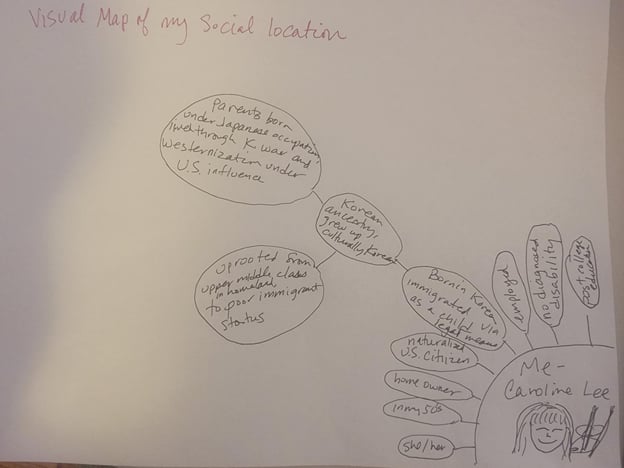
Personal Visual Map of my social location and its relationship with colonialism
As I reflect on my own personal social location, I realize that I embody many attributes that classify me as a person of privilege. I’m a college-educated woman in my middle ages, in a heterosexual marriage, a home owner, employed with a union job, with both kids in college. My family and I immigrated to the U.S. from South Korea when I was a child (via the good fortune of legal immigration paths offered to us by the US government at the time), and my parents worked hard to provide for us so that we can receive the best education in the ‘greatest country’. I guess one can say that we lived the American dream.
My parents, who are still alive and living with me, have a more colorful and varied story. They were born in Korea during the Japanese occupation. My mom’s name is a remnant from a time when girls were given Japanese names. Her earliest memories include Japanese authorities dragging people from the outdoor markets for whatever crime they might have committed. They were freed from the Japanese occupation when US bombed Japan in 1945, but the country was divided in two with the US controlling the south and the Soviet Union controlling the north. When the war broke out in 1950, my dad and his family, who were living in the North, joined the hundreds of thousands who became refugees in their own country. There was permanent displacement of family, properties lost, and he has family members with whom he lost contact even to this day.
South Korea, under the guidance and guardianship of the US, became westernized at a dizzying pace. Although their relationship wasn’t a colonial one in the sense that the US was extracting resources from Korea, the US’s cultural, economic, military presence post war was undeniable and huge. My parents rode the wave of westernization of Korea; they became Christians, went to schools set up by missionaries, embraced the music and culture of both American and European traditions. My dad, especially, fell in love with the American ideals of individualism and opportunity for all, and decided to relocate his family to the US even though they were living a very comfortable upper middle class lifestyle.
When I reflect on what my homeland has become, I have very mixed feelings. On the one hand, its meteoric rise as an economic superpower in the last 60 years is astounding. Recently, cultural exports from Korea to the rest of the world including but not limited to film and tv, music, food, beauty, etc. have meant Korea is a household name in the US and beyond. At the same time, I also observe an incessant need among Koreans to achieve status. One of the reasons why my dad moved to the US was because of the intense social pressure placed among young people to attend college and be on an upward moving career trajectory. Korea continues to have one of the highest suicide rate among young people among developed countries. Materialism and the need to show off your wealth through the accumulation of high end stuff have been a theme for decades, as expressed in the global k-pop sensation ‘Gangnam Style’. Korean Christian leaders have formed their own version of prosperity gospel and amassed large fortunes by promising wealth and well-being by becoming a believer.
As a country who have experienced a brutal and violent colonial subjugation, then have that system be replaced by a more benevolent but no less influential guardianship of a political superpower, I believe Korea of today have experienced a deep and lasting coloniality and Colonial Alienation. Their incessant need to show off their wealth stems from an internalized sense of inferiority.
Korea has a long and rich cultural heritage characterized and built by a nation of scrappy people who fended off invasions constantly from larger neighboring nations. They know how to suffer loss and celebrate bounty. They understand what it means to be in community and take care of each other. We are blessed with a rich indigenous history and culture.
As an immigrant who embodies all of this rich and complex history, I find both the colonized and the colonizer in my DNA. I am an American who has benefitted from the system of subjugating other nations so that I can enjoy all of the comforts of a middle class life in the Bay Area. I am a Korean who in my familiar psyche have experienced the bitterness of that subjugation and the colonial alienation in its many and subtle forms.
How do I engage in the work of Decolonialization? By becoming aware of this reality. By constantly checking where my privileges lie and blindspots. By siding with the oppressed and the marginalized as Jesus did. By celebrating the diverse gifts of indigenous cultures everywhere.
Shiree Dyson
The structure of my identity is centered around my identity as an American born Black woman. All that I have experienced has been through the lens of colonialism. Even defining being Black is counter to the narrative of white America. We all gaze through the lens of colonialism. Colonialism is the infrastructure that claims one’s body, knowledge, culture, and future. It is not just about the past for it still operates today in deciding which history matters, whose knowledge counts and who gets access to resources.
Colonality is the stayed presence of the colonialism without the colonizers visibly present. It’s the structure under which we operate as the descendants of both the colonizer and the colonized. Colonality constantly reshapes systems for its benefit alone. For example the pursuit to make pristine the history of the United States rather than be truthful about its violent history is colonaltiy.
We are currently in the throes of colonial alienation again. What is MAGA? Make American YT again through erasure and displacement. It is this violent erasure of what we believed to be democracy. It is being made foreign in your own country. Domination and oppression of rights and government support.
Decolonization is the continued dismantling of those colonial systems. It is asking who am I, without the frameworks of colonialism. It is stopping the erasure of who I have come to be and staying conscious of how this system operates through and around me. It is about transformation.
Amanda Weaver
Contextual Thinking
Lesson 1: Reflection
Colonialism is when a more powerful nation systematically takes control of a less powerful region through any or all of the following: territorial acquisition, economic exploitation, political domination, and imposition of the dominate nation’s culture and language onto the people of the less powerful region.
Coloniality is the fingerprint that colonialism leaves behind – patterns of control and domination that persist long after the colonizers have left and require work to remove.
Colonial Alienation is coloniality at the level of the individual; it is the way that the control and domination of the colonial power work their way deep into the psyche of individuals disconnecting them from their culture and language and leaving an internalized sense of inferiority.
The importance of decolonialization is recognizing and repairing the harm done by colonization. It is about reconnecting the colonized to their history, culture, language, and anything else that was removed from them by the colonizers. It is about returning them to their rightful place in humanity.
Leonard Bailey
Assignment 1 - Contextual Thinking: Decolonization
Here’s how I’ve been thinking about it…
What is Colonialism?
So, colonialism is basically when a powerful country goes and takes over another place—like land, people, resources—and controls it. It’s not just about showing up; it’s about dominating everything: government, culture, language, even people’s sense of who they are. And for Black folks, you already know—this is how the slave trade, plantations, and all that white supremacy got globalized.
What is Coloniality?
Now coloniality is kind of like the leftovers. Even after the colonizers “left,” the mindset and systems they put in place are still here. It’s the way whiteness still gets treated like the default, the way African knowledge or Indigenous practices are seen as less “civilized.” It’s like colonialism never really ended—it just changed form. Still messing with people’s minds, economies, and identities.
What is Colonial Alienation?
This one hits personal. Colonial alienation is when you’re made to feel disconnected from your own roots—your culture, your ancestors, your language, your body even. Like… you grow up being taught that your history ain’t worth learning, or that you need to act or speak a certain way to be seen as “professional” or “smart.” It’s that pressure to perform something other than yourself just to be accepted.
Why is Decolonization Important?
Decolonization is necessary because it’s about reclaiming ourselves. It’s not just kicking colonizers out of land—it’s about healing our minds, telling our own stories, learning our own histories, and challenging systems that still try to erase us. It’s about liberation. About making space for Black and Indigenous ways of knowing, being, and dreaming that don’t fit inside white frameworks. That’s where the future is.
- What is Colonialism?
- Colonialism is a system in which one nation or power takes control over another land, people, or territory for political, economic, cultural, or religious domination. Historically, colonial powers expanded through conquest, settlement, exploitation of labor and resources, and the imposition of their language, culture, religion, and systems of governance onto Indigenous or local populations. Colonialism often involved violence, displacement, slavery, forced assimilation, and the suppression of local identities and traditions. Its effects shaped global inequalities that still exist today in economics, education, politics, religion, and culture.
- What is Coloniality?
- Coloniality refers to the long-lasting patterns of power, thinking, and social structures that remain even after formal colonialism ends. While colonialism may officially end politically, coloniality continues through systems that privilege Western ways of knowing, beauty standards, religion, language, education, economics, and authority over other cultures and knowledge systems. Coloniality influences how people understand identity, power, intelligence, spirituality, and success. It can shape institutions, media, leadership structures, and social hierarchies in ways that continue marginalizing certain communities while normalizing dominant perspectives.
- What is Colonial Alienation?
- Colonial alienation is the disconnection people experience from their culture, language, identity, spirituality, history, and sense of self because of colonial influence. Colonized communities were often taught to view their own traditions, appearances, beliefs, and histories as inferior while valuing the colonizer’s culture as superior. This can create internalized oppression, shame, cultural erasure, and fractured identity. Colonial alienation affects individuals and communities emotionally, spiritually, socially, and psychologically by distancing them from their roots, collective memory, and cultural dignity.
- What is the importance of Decolonialization?
- Decolonialization is important because it seeks to challenge and dismantle the lingering systems, beliefs, and structures created by colonial power. It involves reclaiming histories, identities, voices, knowledge systems, languages, spiritual traditions, and cultural practices that were suppressed or erased. Decolonialization encourages people and institutions to critically examine power, inequality, representation, and whose perspectives are centered or excluded.
The importance of decolonialization is not only historical but also transformative. It creates opportunities for healing, justice, inclusion, and self-determination. In education, religion, design, leadership, media, and community work, decolonialization encourages more diverse and human-centered ways of thinking and creating. It helps communities restore dignity, challenge oppressive systems, and build spaces where multiple cultures, histories, and perspectives are respected and valued equally.