
Assignment | Journaling
May 2, 2025 11:48 PM
Assignment | Exercise: Journaling
You are encouraged to get a notebook to dedicate to journaling throughout this course. With each exercise that you do, journal the experience.
Reflect on what you learned, what worked, what did not, and what was hard or easy. You are also encouraged to include new techniques you can try next time. And don't forget to include what you are designing and who you are designing for and with.
Embrace that this might be a flash of insight about yourself as a designer, your forming design lens, or a shift in your design consciousness. Record these flashes in your journal and reflect on them.
Discussion (50)
Uh oh,
I submitted my reflection on Thursday morning. It isn't visible. Might you know what happened?
Thank you,
Clark
I am looking forward to applying the tools of design thinking to the process of forming an idea/theme/movement at Epworth alongside my colleagues. We have met a couple times to discuss just what this might be, and so far we have kept it open ended, in brainstorming mode, still very much in divergent thinking mode. I appreciate that we have a whole nine months to come up with something. And that this particular class has taught us the importance of creating something that will emerge in collaboration with our congregation, rather than something that we come and present as fully baked. As we are in the beginning of this, my journal reflection is about the start of the process. And I imagine the entries will be more and more reflective of what works, what doesn't and how the good ideas rise to the top and the less good ideas fall away.
Thank you so much for sharing! I think that pressure--whether internal or external--to present a "fully-baked" idea is so strong for a lot of us! Maybe that's a part of capitalism and individualism to have a story of a singular hero with a brilliant idea who comes in and saves everyone? I am finding feelings of insecurity and anxiety when thinking of working with my community in a truly collaborative, co-creative way, but returning to what we are learning and tying it all together is helpful. Returning to last month's lessons on formation and leadership, we might contextualize this work within Brene Brown's BRAVING as practicing vulnerability.
Thank you for your share!
Rev. CJ
I really appreciate how you’re embracing the process rather than rushing to a finished product. I agree that staying intentionally open and curious in this early stage takes both patience and trust—qualities that are at the heart of co-design. I love your awareness that good ideas will naturally rise as you collaborate with your congregation. It sounds like you’re setting the stage for something truly Spirit-led and community-shaped.
Journal Entry: October 15
Our cohort met for coffee to begin to formulate an idea for our church renewal project. We first spent time reflecting on the Design Thinking course and its implications for our process.
I shared about how difficult it can be for me to take the time to bring in the voices of others and not jump ahead with my particular “brilliant” ideas. I am more solution oriented and find processing to be too slow and cumbersome. I have been through too many community attempts to move forward that have stalled due to loss of momentum when the process takes too long and/or kills interest. My fellow cohort members acknowledged my concern but pointed out that the Design process also includes trying out things along the way. Refining and shifting. It is not a stagnant process, but dynamic. Bringing in diverse voices while simultaneously crafting prototypes and trying them out.
Our church is currently working on a strategic plan. As part of the process we conducted focus groups, asking members to reflect on questions about their experience, desires and dreams for our congregation. In those discussions the longing for a deeper spiritual experience and concern that our faith remain relevant to younger generations were a common theme. Our cohort identified these issues as the focus of our project. One concrete step in the process is to reach out to our pastor, keeping her informed of our thinking. We sense that the project must emerge from the congregation and how our pastor understands her role in this is crucial.
I too have a desire to bring the youth back to church and pass on our faith. I also think it is essential to bring in willing youth to help create an atmosphere that they can thrive in.
I love the approach your church has taken. Everyone seems to be on board and has a similar goal. I like the focus group idea, as well. Keep up the good work.
Your pastor is a crucial part of your success. She is what we call a "stakeholder" in the process, a term that is often substituted for "user" (as in user-centered design). "Stakeholder" is more inclusive and recognizes that "users" may have different relationship with the end product/experience that need to be guaged and understood. No doubt there are other stakeholders with disparate relationship with what you're doing that also need to be included-in understanding the nature of the need, the opportunity that recognizing it presents you with, in brainstorming solutions and in the case of the pastor for sure, understanding the path to implementation and all the factors that need to be considered to ensure success.
As I was watching the video lectures for this week, I realized that I’ve been practicing many aspects of the DT principles and process my whole life as a violist. Practicing a musical instrument to improve my playing and learn a difficult passage requires divergent thinking. I explore every possible options in my toolbox to learn the passage and techniques to see what works. In the end as I prepare for the performance, I have to apply convergent thinking to decide what works the best, and come up with a game plan of how I will execute the actual performance.
Of course, there is the recursive aspect of practicing - the hours of repetition and fine tuning. Musicians iterate, iterate, iterate! There is no way around it. Musicians also need creative confidence to stand in front of people and present our unique interpretation, and when we fail to achieve the ideal performance ( which we do almost always!), we learn from our mistakes and try to improve on them.
The aspect of DT that I need to work on is the collaborative, codesigning aspect. Unlike working toward a perfect performance of a sonata, designing to renew our congregation toward transformation of our community and the world requires the humility to listen deeply and design as a community. As I reflect on this week’s lessons, I realize that I have a tendency to take on tasks and try to do it all, or at least too much, on my own.
The top-down method of solving problems, where one person who believes “I alone can fix it”, whether it’s a political leader, spiritual leader, or a community leader, might be more efficient, if efficiency and quick solutions are what we want. I’m learning that in order to make meaningful, positive changes in our community, the collaborative process, centered around empathy and healing, is an absolute must. I feel that my lifelong practice of being a musician has given me opportunities to practice certain aspects of the DT process, and I’m excited to work with my Epworth cohort to practice those muscles in a collaborative way to renew and transform our beloved congregation.
I can relate to what you wrote about fixing things on our own. So many times we take on the mantle of responsibility for all because we are leaders and believe it is a requirement of our position. However, in ministry, it is most simple and beneficial to all to learn to agree and follow which opens us to new thoughts and ideas.
I love that you bring your music making creativity to this endeavor. If we think of everything we do as a creative endeavor, imagine how our newly learned principles will change the way we operate.
I love the way you explain design thinking using practice/performance as a musician! That idea hadn't occurred to me, but you're exactly right. I realize that I need to extend the grace I give myself for not having a perfect performance into other areas of my life.
Music is a wonderful way to practice the skills and steps of design--particularly when developing new musical arrangement in ensemble-where being comfortable putting your own ideas forward must be balanced with listening to those of others and where this happens in subtle way, even (and especially) without words. Just "knowing" where others want to take a piece and being willing to follow, or vice versa.
M. Cross
Design Thinking
Prof. Neil Goldberg
Lesson 3
What has been interesting while taking this course is realizing we had and are putting into practice tools from the course, particularly, "I used to think/feel…, …but now I think/feel…,
…because of [the experience I had…]. Being creative and open to thinking differently about our approach has really been a blessing for me. I am a designer! Who woulda thought?!
Our ministry is currently re-establishing plans and programs to benefit our congregation as well as our surrounding community which is both in trouble AND and being developed, two things that can help and harm.
The Ecclesial Council recently met with our Ministers' Board first, to check in, and secondly to hear their hearts in terms of where they are and what their call is. Where the 3 member Ecclesial Council had been carrying the load, we came to understand that we have servant ministers with very definitive ideas that would benefit the whole.
In that meeting, it became clear that some of us were looking back to what we used to do with a hope that it would work today. We were able to establish that what we thought, felt, and experienced would not and could not work today nor would we be able to re-create that era. Our congregation is small and the age demographic is not what it once was.
As a result, we were able to come together and define our next move to:
- identify the need (s),
- re-assess and apply the mission statement, the cornerstone of the ministry,
- clearly define our personal ministry mission statements applicable to our future,
- determine next steps which lead to scheduling an all-day think tank session to hash out methods to determine next- steps, and
- bring in others (especially youth) with an ear to their fresh ideas
We left that meeting charged and excited about working together and seeing our ministry grow and flourish.
What a powerful example of transformation in action! I love how you used the “I used to think/feel… but now I think/feel…” framework not just personally but collectively within your ministry. It’s inspiring to see how your group moved from nostalgia for “what used to work” to curiosity and co-creation for what’s possible now. The intentional inclusion of youth voices and revisiting the mission statement shows true design thinking at work—honoring the past while designing for the future.
Congratulations on diving right in with a design team and a plan of action. Stay flexible as you work through the process over time. Incorporate learning around process as well as content as you advance through the plan you've made. Your final point is especially important if you intent is to bring in younger demographics - perhaps make a concerted effort to invite representatives from every demographic you aim to reach to join the team and become part of the solution.
from Deb Anderson
Our congregational cohort, Amanda and I, have been in conversation, though we haven't yet made any final decisions about our project direction. We feel we have a good beginning with an upcoming day retreat we are doing called, "Storytelling Our Future," a half day for the congregation and the other half for the council. It will be led by a ministerial colleague whose holds a PhD in storytelling. I am confident that she'll help us draw out the deeper narratives, values and hopes that live within our congregation that will give voice to our vision and purpose to our CRP process.
The original goal of this retreat was to formulate a mission statement--I'm a real stickler for these--and now I see how "story-telling our future" will also become an important step in design. As "The Field Guide to Human-Centered Design" states, the Inspiration Phase is where we learn to better understand people...where we observe their lives, hear their hopes and desires..." Stepping into the greater community to tell stories, to listen, and to help us "clarify where we should push the design." (The field Guide, pg 31) is for me, inspiration at its best!
I am naturally a big-picture planner, so in design language, I think I am comfortable with holding possibilities, hopes and dreams until the big picture has form. And I often get impatient with details. Through this class's discussion and readings, I'm gaining a new appreciation for the Communal part of the process--the power of slowing down, listening well, and letting the shared stories shape the vision. It's becoming clearer to me that real transformation happens not just through strategy or structure, but through relationships--in the spaces where people feel seen, heard, and part of something larger than themselves. I have a dream.....
Thank you for lifting up the communal part of the process. I think that’s going to be very important to our congregation as well. Storytelling is a great way to raise up many voices. I wish I could come to your congregation and observe the process!
Hi Deb, it sounds like your church has the right approach to getting things done. I, too, wish that I could attend one of your meetings or retreats. I'm inspired by your churches approach.
Best wishes for continued success.
Ken Glass
Deb, I love "real transformation happens not just through strategy or structure, but through relationships--in the spaces where people feel seen, heard, and part of something larger than themselves."
love the emphasis on relationships. I took am a big picture thinker but tend to go it alone. This course is pushing me to see the value of community thinking. The actual value is in the process and in the relationships. The product is almost secondary.
Yes! Storytelling is both a powerful method in the process and a way of understanding what we're doing when we "design". We're "making things up" which sounds a lot like story-telling, and its surprising how closely the design process follows classic story patterns - with protagonists (users, stakeholders), conflict (needs, problems, challenges), a journey of sorts (discovering what's needed, what will address the need, prototypes that work and others that don't) and resolution, return home with the boon (the solution, a new experience, service or product).
Rev. CJ Dunford
Design Thinking for Social Change
Week 3 – Theoretical Models and Exercises
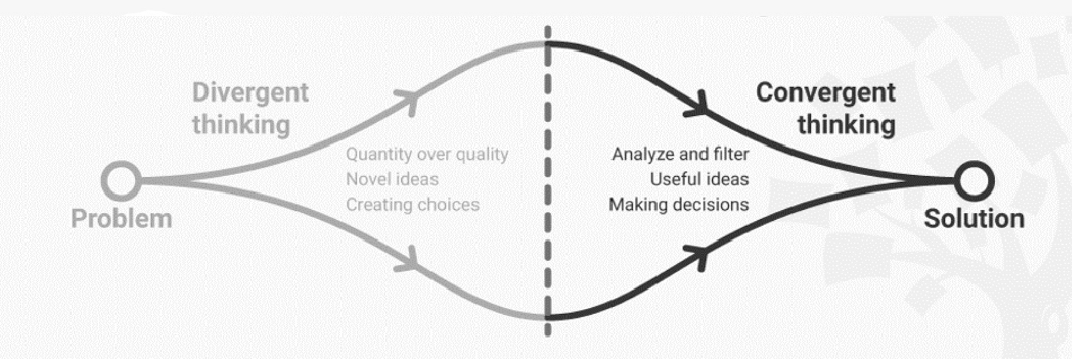
Divergent thinking is a thought process used to generate creative ideas by exploring many possible solutions. It typically occurs in a spontaneous, free-flowing, "non-linear" manner, such that many ideas are generated in an emergent cognitive fashion. Many possible solutions are explored in a short amount of time, and unexpected connections are drawn. Divergent thinking is often contrasted with convergent thinking. Convergent thinking is the opposite of divergent thinking as it organizes and structures ideas and information, which follows a particular set of logical steps to arrive at one solution, which in some cases is a "correct" solution.1
Activities which promote divergent thinking include creating lists of questions, setting aside time for thinking and meditation, brainstorming, subject mapping, bubble mapping, keeping a journal, playing tabletop role-playing games, creating artwork, and free writing. In free writing, a person will focus on one particular topic and write non-stop about it for a short period of time, in a stream of consciousness fashion.
Convergent thinking is the process of finding one solution. Divergent thinking involves more creativity, and is typically regarded as spontaneous. In other words, convergent thinking involves more logical thinking with the aim of finding the most efficient solution. Divergent thinking is more useful for brainstorming to explore multiple potential solutions, with less focus on immediate practicality.
Benefits of convergent thinking:
- No room for vagueness or uncertainty
- Organization and structure
- Quick resolutions
Benefits of divergent thinking:
- New opportunities
- Allows for creativity to flow
- Multiple perspectives
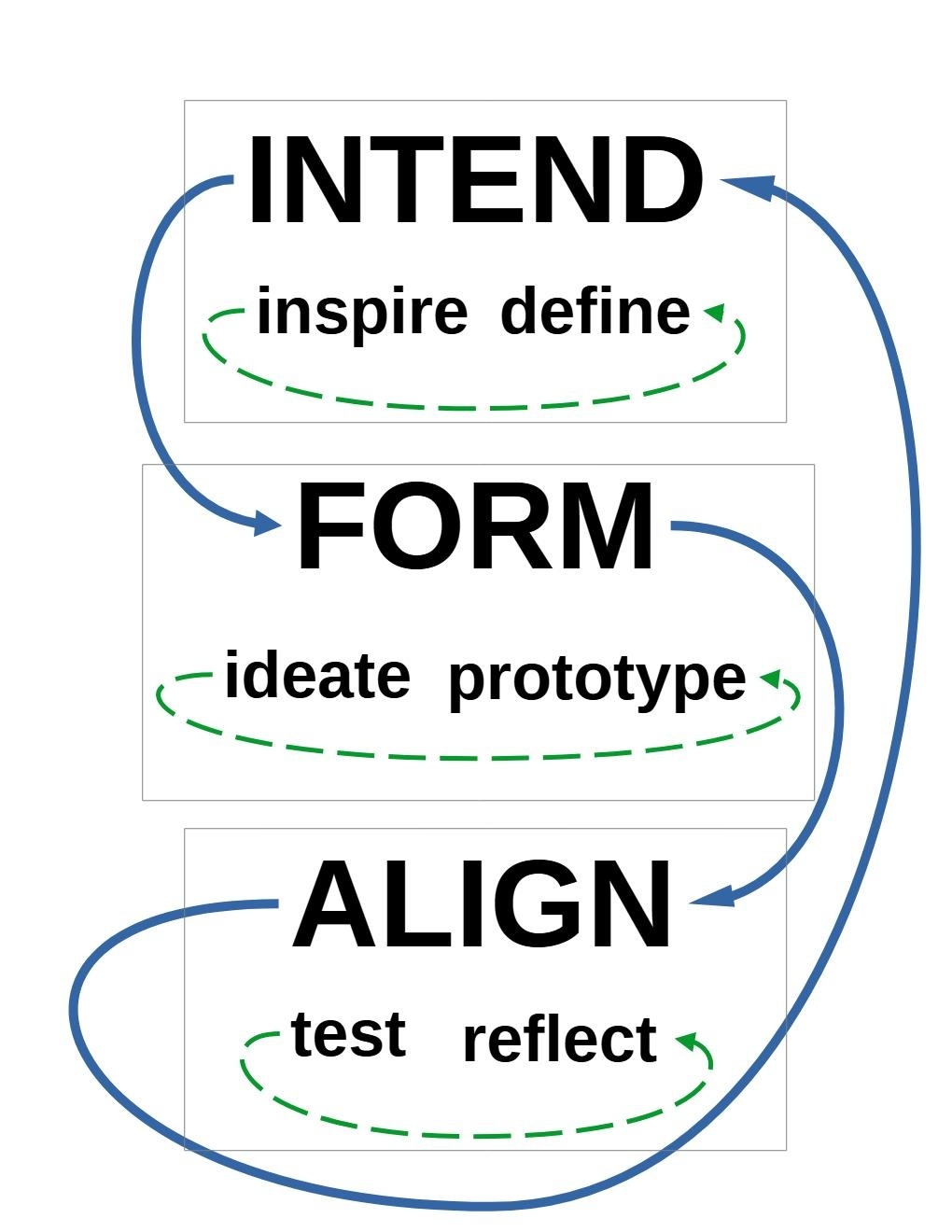
Design is how we give form to our intentions. There are 3 stages in this iterative loop: (1) setting intention, (2) giving form to our design, (3) discover how well we are aligned. They can be further broken down: setting intention requires that we are inspired by something/someone and particular definitions, of problem(s), concerns, concepts, etc. Giving form requires ideation and the creation of prototypes. Finally engaging our alignment requires us to test and reflect on the form we have created. We can spend time within each of these stages before moving to the next and/or returning to the previous stage.
All design is co-design: with the universe and whatever forms they take, with the awesome and divine, with the generations on whose shoulders we stand, with the society we inhabit, with our immediate collaborators, even the simplest object is not conceived of in its entirety by a lone individual. Most importantly, we collaborate with those whose lives will be most directly impacted by the object of our design.
Important questions/considerations:
- How do we build community, create a place for people to belong?
- Uplifting and emphasizing healing-centered practices (esp. with relation to trauma)
- What resources & people do we have here and now?
- What power needs to be redistributed?
- What messaging, narratives need to be uplifted?
- Look for people who occupy specialty spaces (careers, education) both theoretical and practical
- Be strategic in including community in design: brainstorming, collages, direct and indirect involvement
“Learn the rules like a pro so that you can break them like an artist.” -Picasso
Information presented here is intended to be used as scaffolding rather than hard-and-fast rules to always follow.
10/17/25 journal/notes:
I needed to put together the above synthesis because I struggle was struggling with understanding the lessons to be learned, partly because I hadn’t had the chance to meet with my cohort yet and partly because we are both struggling with finding our places within our Buddhist institutions. We may have general popular support from our congregations—and that’s an assumption I’m making and hoping for Victor—but there are so many politics, fragile egos, and complex legacy systems of governance in place, that these larger overarching problems become a distraction from the work that we can, are, and will do in our present congregational context.
Just sitting here and writing this is a good reminder to periodically adjust my zoom and focus. The act of synthesizing the above information was a really helpful exercise in reinforcing the information I’d learned, contextualizing design thinking & ministry, and making connections to what the president at my temple (Berkeley Buddhist Temple, BBT) is currently doing. Fortunately, I had a routine check-in meeting with him today, so I was able to connect the idea of codesign from our lectures to the ways in which he has been soliciting feedback from our sangha. I’m optimistic that we will continue to work together in complementary leadership roles at the temple and looking forward to sharing this new framework with others in the community.
1Psychologist J.P. Guilford first coined the terms convergent thinking and divergent thinking in 1956.
"Synthesis" is such a powerful concept to bring to the design process. We're typically taught how to analyze things so we understand them better, but rarely is the nescessity of synthesis (and re-sythsesis) pointed to as a nescessary step (which connects of course with divergence and convergence - where converge and synthesize are often the same thing). Writing is best understood this way, as in "I write to learn, rather than I learn to write".
R. Lomax
Lesson#3
Course Name DTSC
I’ve learned that my perspective of what design is has changed. I’ve also learned that human centered design focuses on the needs of who the design is for. It’s not just form, but form and function. With that in mind, I am working with members of my church to bring the younger generation back to church. It seems the early 20’s to mid 40’s no longer have a desire to attend. We’ve tried in the past to get them excited about church service, but that didn’t work. We know some may not want to come to church on Sunday morning, so we want to create a space and atmosphere on another day just for them. A space where they can be completely themselves. I’ve reached out to a few in that age group to come collaborate and help put together something that feels like it belongs to them and meets their needs, both spiritually and practically. We want to work together to hopefully change the hearts and minds of the youth that have felt left out of what they’ve known church to be. I am extremely excited about watching things fall into place while leaving room for flexibility. The key to designing anything, is knowing the plan will need to change due to unforeseen circumstances. There is also a beauty in trusting the process, and watching the design develop. This is a faith journey and I trust God for guidance as well as trusting that the people involved are meant to be a part of this journey. (Jeremiah 29:11) For I know the plans I have for you, declares the Lord, plans to prosper you and not to harm you, plans to give you hope and a future.
Perhaps one of your intiial projects will be to come up with ways of getting the young people you want to bring to church to become central in the design process itself - understanding the needs, brainstorming solutions, and doing the important development work to make sure THEIR needs and the needs of their age cohort are met in way that they relate to.
I love this there are so many new ways to reach the young adults, we just have to meet them where they are and find ways that they can truly be able to worship in their authentic truth...everyone's faith path is not the same...like you said in my favorite scripture Jeremiah 29:11 if we can just grab a hold of this we will have a future.
As I reflect on this week’s assignment, the idea of journaling, and on the lessons learned so far in this class. First, I feel fortunate to have this experience and to get the opportunity to hear from so many different perspectives. The readings have been eye opening and mind expanding. Especially from a spiritual perspective. I am curious and want to learn more.
While going through my Co-Active Coaching training program, I acquired important transferable skills. The program helped me improve on the skills of listening, using intuition, being open and curious, as well as self-management. These skills are essential and should be includes in all “Human Centered” designs. I have incorporated them in my daily work with others. Especially when collaborating and interacting with individuals and teams on projects. It has helped to minimize ego driven meetings and tension in meetings. I am looking forward to playing in the virtual sandboxes and collaborating with others to find ways to inspire and re-energize members of our congregation, especially the youth. It is going to be necessary to include them in the initial steps of the process to ensure that they know their voices are necessary and welcomed in the process.
I know these are just my ideas. However, it is my intention to go to the initial meetings with an open mind and to listen to what individuals are saying. That way, I can determine where my skills are best needed and know when’s the best time to share my ideas. It’s my intention to establish an agreement that promotes the mutual respect for others in order to create a safe environment for individuals to feel comfortable with sharing their visions for the church, what’s important to them, and why. I believe this could be a good starting point to Co-Creating something that inspires everyone to want to be engaged in the process. However, I do know this will not be an easy feat, but it is important work that must be done.
Refer to the post I just made above about the importance of getting people from the demographics you want to serve ON your design team(s), and possibly making that your initial design challenge.
I totally agree with this vision it's similar to mine I just want to help save souls, so many people are searching for real love and community I just want to find ways to reach them and bring them to unconditional love and Grace
VOgundipe-L#3-DTSC
Reflect on what you learned, what worked, what did not, and what was hard or easy. You are also encouraged to include new techniques you can try next time. And don't forget to include what you are designing and who you are designing for and with.
There are so many insights that I am having as we learn in the Design Thinking For Social Change course series and the broader CRC. I will share three for now. All of these insights have have brought me back to my spiritual traditions in a deeper way:
1) “The designer must be able to step into other’s shoes to sense what is needed from the perspective of those with the need”
The importance of empathy discussed in design thinking is something that brought me back to many lessons in the Buddhist tradition. How do we step into the shoes of another, in a real way? And, as pointed out in this week’s video lectures, how do we make doing so a practice?
For me, I found inspiration in the Upaddha Sutta (SN 45.2). In this scripture, the Buddha’s cousin, Ananda, posits that spiritual friendship is half of the holy life. The Buddha encourages him to think more broadly and insists that spiritual friendship is the whole of the holy life.
To say that spiritual friendship is the whole of the holy life could also be viewed as saying that stepping into the shoes of the other is the whole of the holy life. Service is the whole of the holy life. To be a designer is to be a true and accountable spiritual friend, able to listen deeply, able speak in ways that open up successive and deeper layers of understanding, and able to walk the path together in a way that separation between self and other continually decreases as relationship deepens. The empathy inherent in spiritual friendship makes it possible for the designer to, “step into other’s shoes to sense what is needed from the perspective of those with the need”. To be a true spiritual friend is to practice the empathy required for design.
2) “Empathy + Creative thinking”
The importance of the combination of empathy and creative thinking in design thinking has deep resonance with the Buddhist tradition’s focus on the important and inseparable relationship between wisdom and compassion. These two are often described as the two wings of a bird, both necessary and both bolstering each other. To the degree that we are focusing on design thinking in a spiritual context (or the spiritual aspects inherent in design), it is helpful to be able to see design thinking lessons through spiritual language.
3) "I have not failed. I've just found 10,000 ways that won't work"
One thing that Dr. Goldberg mentioned this week that stuck out is the importance of confidence, and the danger of hubris. One thing that may be able to help us in this regard is openness to failure as a necessary step in breakthrough. As Rev. CJ and I begin this work, we know that we will have failures along the way. I think that this is why Dr. Goldberg encourages us in regard to the importance of partaking in thoughtful action, actually doing design not just thinking it in our heads, because even with the best planning, we can’t anticipate every challenge that we will run into. But, the ability to accept failures, not resist failures, learn from failures, and to ultimately view failure as a partner in design will help us both design in a way true to the community realities and possess the capacity to turn towards each other when facing the difficulties of failure.
The brilliant thing about the wisdom traditions is that they are fonts of guidance to the design process when approaching them with a design lens. You're making wonderful connection between "classic" design thinking theory and Buddhist wisdom and as you deepen your design practice I hope you will find many more -both for understanding the underlying principals as well as for inspiration and reassurance that you are on the right path. Like all spiritual wisdom, though, we must stay vigilant to not look for the easy way out, or for "bypassing" the hard spiritual guidance we receive.
Listening to the videos, I realized that divergent and convergent thinking is something that we do at work most of the time when working on updating existing programming or innovating new programing. We call it the dreaming stage and the realist stage. The dreamers come up with the ideas, and the realists help whittle those ideas down to just the ones that are workable (and affordable). However, there’s a tendency to silo people as either dreamers or realists, either due to personality or job title. I liked the idea that everyone can be part of both aspects of thinking.
The idea that the steps of design thinking don’t have to be followed in order also spoke to me. Instead of thinking of design as a linear process with a clear start and end, I like the flexibility that the spiral process of repeated steps offers. I tend to be a perfectionist, so maybe I just needed the permission to present something that isn’t 100% perfect and done, but still needs more testing and revision.
Dear Amanda,
I hope all is well! As I read your post the aspect of the freedom in the design process as we get more skilled kept coming to mind. I also loved your focus on what I perceived as an anti-silo mentality. I am taking away inspiration regarding courage and connection from your post. Thank you, I am grateful for having received your insights :-)
I hope for you that this course gives you all the permission to "fail" that you need to stay inspired. And remember to include both dreamers and realists on your design teams at every stage of the process - just recognizing which of those skills to lean into as the process calls for it.
Leonard Bailey
10/15/25 - Lesson 3 - DTSC
Journal Entry – Design Thinking for Social Change
What I’m designing:
Tools and systems that support care and access for folks dealing with structural barriers—especially elders and families needing non-medical home care and broader community needs too.
Who I’m designing for:
Mainly older adults and families navigating care needs, but also communities that are often left out of traditional systems.
Who I’m designing with:
Ideally, the people most impacted—clients, caregivers, neighbors, community voices. The ones who really know what’s needed.
What I learned:
The first week surprised me—in a good way. I used to think of design as mostly visual stuff (logos, flyers, physical things). But now I see design thinking as a whole mindset, a way of understanding and navigating the world. It’s not just about making things—it’s about values, choices, and systems. And it’s a real form of knowledge that sits outside science and the humanities. That reframe really hit me.
What clicked:
I liked the idea of design being a back-and-forth process—figuring out the problem as you come up with possible solutions. That “commutative activity” concept made a lot of sense. It reminded me that staying curious and flexible is key, and that clarity often comes from doing, not just planning.
What was tricky:
The readings were a bit dense. Archer’s language took a few passes for me to really get it. I had to sit with the difference between design methodology, modeling, and how that all plays into real-world design. It’s getting clearer, but it took some effort.
I also appreciated the reframe of Design Thinking as its own form of knowledge; it was freeing to not feel like it needed to be squashed into one framework or another.
It looks like you've got a good start on identifying who you are designing for/with. One of the things I struggle with is getting away from an everyone mindset when working on my projects.
Dear Leonard,
I appreciate the way that you approached the journaling assignment as an opportunity to gain more clarity around the work that you will be perusing. It is inspiring me to do a similar exercise. Many thanks!
Oh, and "He's Alright!" indeed! Thank you for all you do!
Thank you for even sticking with the Archer paper to get through it. I include it because of the profound effect it had on me when I read it forty years ago--the notion that design isn't only a process a method, but a distinct way of knowing the world was inspiring then, and has been helpful to me ever since.
What has given great privilege to me is how I’ve incorporated my learning into my production life. I did not realize how much I needed design thinking, and how it genuinely shapes my response as a leader authentically.
It wasn’t until today that I could identify what my reflection is to date in this course. I'm grappling with how design thinking applies to my identity as a designer. I already know the iterative process. I refine patterns across body types. I manage the back-and-forth between generating ideas and narrowing them down. But naming it as a formal framework felt new, which created friction.
The scope is bigger than I initially recognized. I've designed public programs for audiences. I've designed internal programs for staff enrichment. I've shaped experiences, not just objects. Yet I still organize my work around the same process—divergent thinking to generate ideas, then convergent thinking to refine them. That pattern holds everywhere I work. What struck me is that self-awareness of noticing my own tension, frustration, what I'm projecting which matters in collaboration. My internal experience shapes the work and the relationship.
But here's where I got stuck. I couldn't reflect on something I'm still actively unpacking. I haven't settled whether I call myself an artist or a designer. This newly introduced framework asks me to identify myself within it, and I can't land there yet. Writing about it felt premature because the process isn't finished.
So I'm left feeling tangled. Not because the framework doesn't apply to me. But because I'm realizing this framework asks me to examine myself in real time, while I'm still becoming. I have evidence of my design thinking across multiple contexts, yet I can't name who I am doing it.
That confusion matters. It's not a gap in understanding. It's where growth happens.
What if the real work isn't settling on a label, but staying curious about how you move through design across all these different spaces?
What a lovely reflection from within the messiness of ambiguity and mystery! There are so many cultural overlays to what we understand with the terms "artist" and "designer". Giving form to intention is what I think of as the central "art of design" where by "art" here I mean it in its original sense, which is as an elevated skill of making that is equally applied to elevated "artifacts" like painting and sculpture, as they are to the commonplace, such as furniture, software, or community services.
L. Durden
Lesson#3
DTSC course
First I want to thank you for understanding, and letting me make up this lesson.
Hopefully I'm understanding this assignment correctly. So bear with me.
I used to think/feel:
I never really thought of design as thinking. When I thought of design, I thought of fashion, designing or putting together something that makes someone or something look good.
But now I think/ feel
Since I've been in this course of design thinking my thought pattern has definitely changed a lot.
I've been what you may call a convergent thinker for so many years, thinking of church in a conventional way because of the way I was brought up and taught to do and act a certain way. But since I've been learning about design thinking I'm learning I want to be a divergent thinker and collaborate with like-minded people, trying to find new ways to start street ministry. I see so many people struggling on the streets daily.
Experience
I want to collaborate with some individuals who may have resources for those who are. unhoused, been through what they call church hurt and find ways to reach young ladies on the streets of Oakland who's being trafficked and on drugs. Because telling my testimony I've experienced it all. And it's sad that this has really become a normal way of life for some and no ones really doing anything to really help save these souls. Every now and again someone might feed or clothe them, but are they praying for them really reaching them, showing unconditional love constantly?
I want to create a loving and safe space in my journey so I can connect with those who are searching for unconditional love and God's Grace. I believe through prayer and community we can come up with ideas that could change lives and help us do this Justice Work.
Ime H.
Mindsets, Skills and Methods of Human Centered Design
In this section, I am becoming more aware that design is not just something I do — it is a way of seeing. What I am designing right now is the evolving structure of Bethesda’s Pool: its nonprofit formation, its grief support model, and the integration of therapy and spiritual care. I am designing for people navigating trauma and grief, and with the ministry leaders and caregivers who are walking alongside them.
One thing I learned is that human-centered design requires slowing down. Listening is not a preliminary step — it is the work. What worked for me was engaging leaders in honest conversations about sustainability and structure. What felt harder was resisting the urge to jump quickly into solutions. I noticed that I often want clarity and closure, but design thinking asks me to stay in curiosity longer.
An insight I am beginning to see is that my design lens is pastoral. I naturally think about emotional safety, dignity, and spiritual grounding. However, I am also realizing that I need to strengthen my systems lens — thinking about funding models, governance, and long-term sustainability. That is an area of growth for me.
A technique I want to try next time is asking more open-ended “why” questions and sitting longer in silence during interviews. I also want to map out the participant journey visually — from first contact to ongoing care — to better see gaps or friction points.
A shift in my design consciousness is recognizing that I am not just starting a ministry; I am shaping a system that influences how people experience healing. That realization feels both sacred and weighty. Design, for me, is becoming less about building something impressive and more about building something faithful.
This design thinking process has been both affirming and stretching for me, particularly as I reflect on how my design lens has shifted through each stage. I am designing the Rhythm of Grace model, which is a spiritually grounded approach to equipping churches and individuals to walk with people through grief beyond the funeral. This work is being designed for ministry leaders, caregivers, and church communities, and importantly, it is being shaped with the voices and experiences of those who have both experienced grief and supported others through it.
One of the most significant things I learned is the importance of moving beyond my own experience. I initially began this project with my personal understanding of grief, but the empathic interviews revealed patterns and needs that I would not have identified on my own. What stood out most was that people genuinely care and want to support others, yet they hesitate because they do not know what to say or how to show up. This insight shifted my understanding of the problem from a lack of compassion to a lack of confidence and formation. That realization became a turning point in how I approached the design.
What worked well in this process was the empathic interviewing and the willingness to listen without trying to guide or fix. Allowing space for people to share openly led to deeper insights, especially around the gap in care after the funeral. Another strength was the iterative nature of ideation. I found myself naturally exploring different approaches—from focusing on ministers to expanding toward a broader, formation-based model for the church. This flexibility helped refine the concept into something more holistic and applicable.
What was more challenging for me was narrowing the focus and clearly defining the problem. Because I could see multiple needs and possibilities, it required intentional effort to synthesize the information into one central challenge. Additionally, stepping into the prototype phase without having everything fully developed felt uncomfortable at first. I am accustomed to wanting things to be complete before sharing them, but this process required me to embrace simplicity and test early ideas rather than perfected ones.
One of the easier aspects for me was ideation. I found that I could naturally generate ideas and frameworks, particularly as they relate to spiritual formation and presence. However, this also required discipline to ensure that the ideas remained grounded in the actual needs expressed in the interviews, rather than becoming overly conceptual.
As I move forward, there are several techniques I would like to try next time. I would like to incorporate more visual mapping earlier in the process, such as storyboards or journey maps, to help organize insights more clearly. I would also consider engaging a small collaborative group earlier on, even informally, to help surface perspectives I may not see on my own. Additionally, I want to continue developing my ability to prototype quickly and test ideas without overdeveloping them first.
One of the most important insights I gained about myself as a designer is that my natural inclination is toward formation rather than function. I am not simply designing a program; I am designing an experience that shapes how people show up for others. This has helped me recognize that my design lens is deeply rooted in presence, empathy, and spiritual attentiveness. The shift in my design consciousness is that I now see design not just as creating solutions, but as cultivating ways of being that influence how people engage with real human needs.
Overall, this process has reinforced the value of designing with people rather than for them. It has clarified that meaningful and sustainable solutions emerge when we listen deeply, remain open to change, and allow real experiences to shape the direction of our work. I am more aware of how to approach design as an ongoing, reflective, and human-centered practice.
It’s so amazing how it’s interestingI’m past the definitive problem and focus on a guaranteed solution. Thankful that I’m able to realize the importance of the process of what went right and what went wrong compared to always feeling like I have the ultimate solution.
Throughout this design process, I learned that design is much deeper than creating something visually appealing. I am designing experiences, systems, communication, and environments that shape how people feel, interact, and engage. The project challenged me to think beyond aesthetics and focus more intentionally on people’s needs, emotions, and experiences. I realized that good design requires empathy, structure, flexibility, and purpose.
What worked well for me was brainstorming ideas through storytelling and experience-building. I found that when I focused on the audience first, my ideas became clearer and more meaningful. I am designing for communities, audiences, creatives, and individuals seeking connection, empowerment, and inclusion. Whether through ministry, entertainment, branding, or live events, I noticed that the strongest ideas emerged when collaboration and human experience were prioritized. Designing with people instead of only for people created stronger and more authentic outcomes.