
Assignment | Lesson 1 | Theology is A Person Place, and Thing
February 26, 2026 10:53 PM
Assignment 1
Share your theological autobiography (see Part 1 and 2 in Task 1) by posting it directly in the discussion space as well as uploading it to the instructor. Record a video or audio to share, or write a document and post it in the discussion space. Your theological autobiography should not exceed 800 words (there is no minimum word count) or 10 minutes if recording.
Assignment 2
Select a theological autobiography that was written by one of your learning partners in the class. Using the framework that Dr. Miles shared in her lecture, analyze their theological autobiography using the following reflection questions as a guide for your response. Then, reply to their theological autobiography and share your analysis in a post that is no longer than 500 words (there is no minimum length, or five minutes if recording your response).
- What theological or spiritual insights did their story help you gain? What similarities or differences did you see between your story and theirs?
- What themes about God or the divine did you see at work in their stories?
- How do you categorize their theological autobiography, as Dr. Miles shared the different typologies in her lecture? Are they Wanderers/Seekers, or Scholars/Philosophers? Pilgrims/Missionaries? Mystics/Visionaries? More than one? None of these? Something else?
- How did their story help you understand your own theological autobiography better? Or: What questions did their theological autobiography raise for you about your own theological autobiography?
Discussion (16)
“All those people goin’ somewhere
Why have I never cared?
Give me your eyes for just one second
Give me your eyes so I can see”
-Give me your Eyes, By Brandon Heath
I woke up to the realization that I had lost most of my “closest friendships” overnight. I had decided to leave a campus ministry at Chico State University after a slow epiphany that they utilized control and fear as their primary evangelization techniques. I had spent three years building close knit relationships with these people, including being considered a student leader and someone who was “developing in wisdom”. I had recently had conversations with multiple people who had left the group, including a young woman who tearfully told me how she was encouraged to stop speaking to her parents, and break up with a boyfriend. I could no longer stay involved. But surely, I thought, some of the friendships would remain. After all, those friendships were based on more than just association in a club. I was wrong, and very quickly word spread that I was falling “to the ways of the world” and that I was not to be communicated with.
For a number of years after that, I shunned any kind of organized religion, preferring to focus on my spirituality and my personal relationship with God. But after getting married and the birth of my first daughter, I felt this hunger to be back in community with people, and give my children the opportunity to grow up in a loving community of people who could educate her in her faith. We had been trying multiple churches when we came across First Christian Church of Chico at the downtown Chico Pride celebration in 2016. Christians, at a gay pride event? And not protesting? We went for our first Sunday, and that evening we got the word that a close family friend had been killed by a drunk driver while out of state. Having barely known us for more than a day, the folks at FCC prayed for us, supported us, encouraged us, and held space for us. We immediately knew we were “at home” inside that Sanctuary.
This was a pivotal time for our nation as well, as it became clear that Donald Trump was a real contender for POTUS, and as I grew in the depth of my faith, it was also being challenged by the circumstances of the world around me, discussing issues of morality with both conservative and progressive family members, and debating the very basis of the idea that children should not be separated from their parents, no matter the circumstances of their arrival in our country. In those early days, I wanted to fight with anyone, prove them wrong with facts, statistics, and logic. I’ve been learning since then that intentionally engaging with people on values driven issues is best done with compassion and being “impeccable with my word” as Don Miguel Ruiz writes in The Four Agreements.
God continued to show up for me, and deepen my faith and reliance on God. And in the last few years, I feel that God is bringing me closer in both love and understanding, but also a desire to learn and deepen my understanding of my faith, other people’s faith, and to use my privilege and my strengths to uplift people. I’m still growing in my faith and in my understanding of my place in the broader Christian community, but I’m grateful to be doing it alongside lots of other wonderful people I’ve met along the way.
Hi Maxwell, thanks for sharing your theological autobiography! I see a lot of connections between the people and communities in your life and where God shows up for you. God shows up in your life though the roughest moments but also in the tending to and caring for the wounds from those moments in your communities. I also see a deep sense in how what we believe has to be backed up by the way we treat one another. One more thing: Do you have a song or hymn that is meaningful to you that helps you know or understand God in your life?
Thanks very much again! -- Dr. Yuki
Maxwell,
Thank you for telling more of your story here. I can relate to some of these experiences in ways that I left the Catholic church, similarly to how you left your campus ministry. It wasn’t aligned with how I wanted to live my life. I didn’t have to lose people along the way, but I am familiar with those kinds of transitions in life.
Also, like you, I sought to find a church after the birth of my first daughter. It was important to me to have a faith foundation for her, and while my focus was on her, God brought me to FCC North Hollywood, which changed my own life. I feel that God led us to our churches for reasons that continue to work for us. It’s also important to note that your faith in God allowed you to be open to letting FCC Chico into your family. When you’ve spent some time away from organized religion, that can be very difficult. Your story might help people who have some church-related trauma.
I feel like you could be bits and pieces of a few of the typologies in Rebekah Miles’s video, but the strongest one I see from where you came from would be a Wanderer/Seeker. I feel that the typologies that we identify with at different times in our lives can change. Where we came from might not exactly be where we are or where we are headed.
Your story has shown me that in my own life, I had to take a leap of faith by allowing myself to be vulnerable to my church. As a Catholic, church was something I absolutely had to do. As a Disciple, church is something that I want to do. Giving myself the freedom to make that choice could have been scary, but I can see how God was with me the entire time, which made it easy and what made it feel so right. Thank you again for your story!
Y'all get ready for a ramble...Apologies up front!
Sometimes it’s in the moments that I’ve forgotten, and sometimes it’s seeing myself through others' eyes…
I have lots of stories that immediately come to mind that I recite about what has shaped me and brought me here to this moment. Most of them are stories of other people recognizing something in me that I didn’t see in myself. Like the time I was sitting in the Chapel of Transfiguration at the base of the Grand Tetons with my both of my kids, taking in the silence and peace, and then one of them said, “You should go to seminary, Mom,” and the other said, “Yeah, you love God so much.” Or the time when my pastor very casually asked me to help with something because he said, “You’re a leader in this church. People listen to you.” I recently had a friend going through a particularly rough time within our church, and we spent hours upon hours on the phone, and he said, “Thank you for this time. I needed your faith-based perspective.” None of these things is anything that I would have ever considered about myself. Ever. Seminary? No. Leader? Ha. And, yes, while I am grounded in faith, I didn’t realize it was coming through in my conversations. While I didn’t see it in myself, I’m glad others did, and I’m so humbled by their thoughts of me.
The story I forgot until today, while walking, was one that happened back when my kids were in elementary school. I received a call from a friend who had a child in kindergarten at the same public school as my older kids. She was upset that she had received an email letting parents know that the annual Polar Express party was being canceled due to the “strong Christian theme of the book,” however, please do not forget to sign up to bring items to the Hannukkah party the following week. I want to say that I said something badass like “We ride at dawn,” but I’m pretty sure it was more like, “I’ll schedule a meeting with the principal and we can sit down to discuss it with her.”
What followed was one of the worst weeks of my life (which is probably why I blocked it out). We met with the principal, where I spent an hour trying to explain why it was so important to commit to all or nothing in these moments. Let us all share and teach each other our traditions, or let’s keep off of it entirely. I advocated for all faiths, cultures, and traditions. I cited LAUSD policy. I shared my experience of teaching Sunday school at my Christian church, where half of my class was Jewish, and how amazing it was to have conversations with second and third graders about our commonalities.
This story did not end well. The principal told people that “someone” was trying to shut down the Hanukkah parties without the rest of the context. It didn’t take long for people to figure out who the “someone” was. I was called an anti-semite on Facebook. I received a phone call the next day from the principal asking me if I would like to have security escort my children to me at pick up because she was fearful that they or I would be attacked. This is all because I had pleaded for a more inclusive vision for the school.
I’m not sure how this story fits other than I am so deeply committed in my heart to letting people have the space to be who they are. As it turns out, I raised two kids who followed my lead because they both spent quite a bit of time in administration offices at school advocating for others and helping to create safe spaces. I’m so proud of them!
These are just little glimpses of many stories of how I came to be here and what I believe. I’ve been encouraged to live out my faith in a more life-giving way, and at the same time I can look back and see that I’ve been on this path of meeting people where they are and lifting up others’ voices.
I’ve always loved songs that seem secular at first listen but aren’t. “I Will Wait” by Mumford and Sons is one that I particularly love, especially the lyric, “Raise my hands, paint my spirit gold. Bow my head, keep my heart slow.” Slowing down, listening, in praise and love. That’s what I see when I hear that. I love it.
Hi Erin, thanks for sharing this story. Oh gosh, the perils of doing interfaith work with people who don't fully understand that Christianity is a tradition that can exist alongside others without overbearing them, and also being aware of the ways in which Christianity holds the majority position in the US. Your theological autobiography (and the song that you chose to reflect on as part of that biography) definitely show your familiarity with humility as a spiritual practice and theological position, and a guiding force in the work you do with your communities. Thanks again! -- Dr. Yuki
I felt like I connected with Erin’s story, especially related to “seeing myself through others eyes”. I have a bit of “imposters syndrome” and sometimes don’t see my own strengths or accomplishments until someone holds up a mirror and says, as in Erin’s case “you are a leader [here]”. I’m sure a lot of people feel that way, wondering what qualities God may see in them. But at the same time, those are our gifts and we should use them to advance God’s will in our lives and communities.
One of the themes I noticed in Erin’s post was her emphasis on justice and inclusion. I can tell Erin’s ministry is open-minded and ecumenical, respecting all viewpoints even if she doesn’t share them personally. I suspect Erin finds meaning and connection in community with other people, even and especially people who are different from herself, which will allow God to build a coalition of trust through her and her communities.
I see some of a pilgrim/missionary typology in Erin’s work, and a desire to advocate for what is just even when it is unpopular or even when receiving misguided anger. But I also see a curiosity and open-mindedness that may fit with a wander/seeker. It is interesting how these typologies can cross-over and blend.
Erin’s statement about her own children becoming advocates for justice is compelling to me. My children are younger (10 and 4), but I can already see a generous spirit in my older child, who is very focused on what is “right” and how to be a good friend. Thank you, Erin, for sharing your story.
Hi Erin,
It’s so nice to hear more of your story and how God has moved with you through life.
Your reflection about other people seeing gifts in you and helping your brain make the connection with ministry and leadership is so good. It felt familiar to me in how people planted seeds within me. They gave me opportunities to lead and encouraged me to think about where God was leading me. Without the support of and nurture of these people AND their ability to see my heart (like your daughter!) I don’t think I would have been so clear about a call to ministry. How cool to be in a community that appreciates your presence and vision and love for God.
In terms of themes about the divine that come through in your storytelling, I see justice and inclusion and community and humility all intertwined. If God is for all people, then it’s worth explaining to the ‘powers that be’ how it’s better to be more inclusive than less, or trying to explain that equal treatment looks like ‘we do all of it’ or ‘we don’t do any of it’ (referring to the school celebrations). It takes courage to speak up for others and work on behalf of a larger community who may be feeling turned away or left out.
Part of what I have learned through your story is that living in integrity and being faithful to your values doesn’t always have a happy outcome. You can do your best but still end up feeling misunderstood and mistreated. Other people’s understanding and reactions are outside of our control. And, still, I wonder whether you would have done anything differently, knowing how it ended? It’s very possible that taking those risks to stand by the values of our faith still feels more important than the actual outcome. You got to be true to yourself and stand up for your community even if it was misunderstood. This is something I’ll keep thinking about!
I see your autobiography falling somewhat under wanderers and seekers as you sought the right setting for your faith connections throughout your life. When you realized one community wasn’t working for you, you moved on…maybe into a wilderness for a while?...and then kept seeking until you landed in a faith community and tradition that felt like a good fit for you and your family. I think that the pilgrims and missionaries category might be a good fit because you’ve shown that going through adversity is not comfortable, but you can stay faithful and learn something about yourself in the process. You still keep showing up!
Your writing made me realize that I didn’t include much about justice-seeking in my own assignment - but that feels like a big part of my journey too. I’ll have to think about that as well. Thank you!
As I considered the questions of who and whose I am, I remembered my mother insisting that we get a family photo at the front of the sanctuary on special holidays. When me and my four siblings were dressed up for Easter or Christmas and the sanctuary was filled with poinsettias or lilies, my mom could not resist having us gather at the front steps and requiring us to stand still and smile at the camera. We didn’t always cooperate. I remember being annoyed more than once, especially when the photographer took their time!
Somehow, as these things tend to do, that urge to snap a photo of my family on holy days has been passed down to me. I don’t have as many of these pictures of my current family as we do of my family of origin, but the ones I have are dear to me. I don’t regret making my own kids stand still and smile to get an image of us together, looking sharp and standing together in church.
What this progression of memories highlights for me is that most of the identity that I claim is as a family member - a daughter, a big sister, a mother, a spouse - and as a person of faith. Flipping through those photographs someone would be able to see how I have grown and changed through my life. Once the oldest of three, then the oldest of five children. Early on with both parents, then with just my mom. Later with my partner, then as a parent of two and also a minister, and finally as a family of six. Churches in different states - Washington where I grew up, where I experienced a call to ministry and where the mountain sang my name; California where my ministry has taken root and where the Redwoods give me deep peace. Sanctuaries that represent the growth and expansion of my faith as I moved outward and grew inward over the decades. Families embedded in community, valuing the holy celebrations of faith and life in the places we are nurtured and loved.
When reflecting on the events that brought me here, I thought of two experiences that, while common among many of my generation, still feel very personal and transformative to me. The first is attending Disciples summer camp in what is now the Northern Lights Region. I went to camp every summer of my life from the age of three until I had just graduated from high school. It was a place and a program that together helped me meet lifelong friends, understand my own self and who I was becoming, appreciate the sacredness of nature and creation, and begin the practice of seeing God in everything. At camp I learned to let loose and dance because I wasn’t afraid of judgement. I learned how to sing in harmony while someone strummed the guitar. I got to ‘preside’ over communion for the first time because I was invited to lead. Having sacred experiences in a sacred space where I felt safe and nurtured truly led to a deeper devotion within me. It was at camp where I first felt a sense of calling to ministry and it was the setting where I first whispered it out loud. It created a foundation of faith within me that still inspires me to listen to the still small voice within and look up at the night sky with eyes of wonder and gratitude.
The second common, yet personally transformative experience was living through the events of 9/11 and their aftermath. I was just coming of age in the fall of 2021, literally having turned 21 at the end of July. I was entering my senior year of college, living far away from my family. The grief and the fear and the outrage of that day were the first time I had experienced such a shattering of my world. It was the beginning of an adult ache and longing for healing in the world amidst so much brokenness. It opened my eyes to the kind of hatred and othering some people seem to default to when there’s an opportunity to act powerful.
In becoming so aware of the hurts of the world so quickly, I was led to dig deeper into my Christian values of peace, compassion, and connection across difference. I attended protests, led candlelight vigils, and lamented the loss of life and innocence among the people whose homes had become a war-zone. Through the lens of this experience my vision was expanded and my compassion grew. I learned that God could be present even in tragedy and through sorrow, and I began to rely more deeply on the promise of a better future for all of us through God’s grace and love.
Bonus pic of my family in December 2017 - one of my faves:
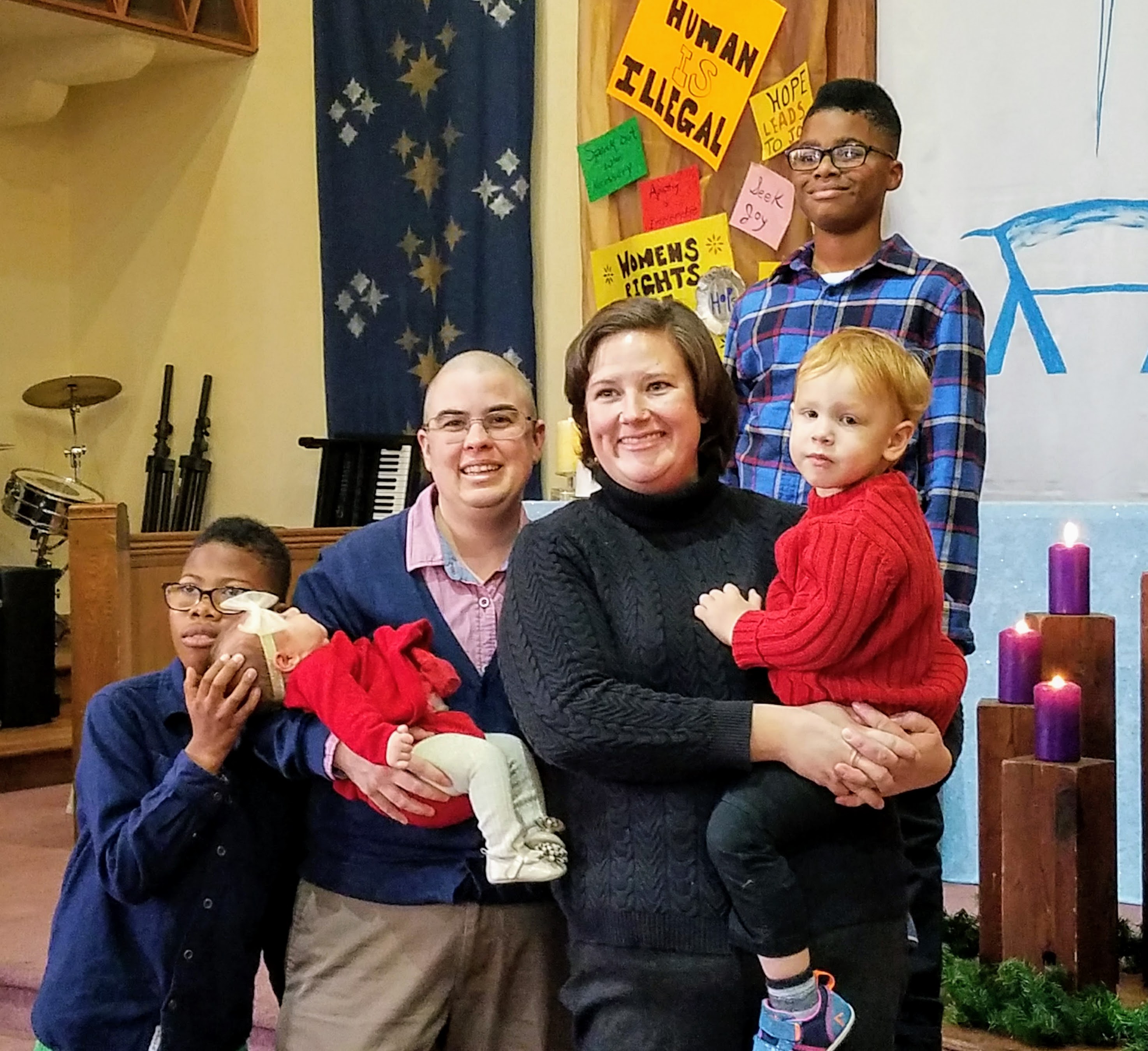
Hi Sara, thanks very much for sharing your story with us, and the photo that is a deep part of your family story and history. The word that came to my mind when I was reading your story was rooted. You are rooted in your family and traditions, and like the roots of a tree or other plant, you may venture out into the world away from your root structure, but you never fully disconnect. And, you have roots in land and space, in community and in those communities. Like Maxwell and Erin, your theology is rooted in the communities that nurtured you and the actions of care that help you and others in those communities make it through the world. Thanks again for sharing! -- Dr. Yuki
I am Annie Richardson. I am the mother of three and a widow. My husband of 31 years passed away in 2018. I am retired. I am a student.
I attend Abundant Life Christian Church and I’m very active there. I retired from NASA’s Jet Propulsion Laboratory (JPL) in 2021 after 43½ years and continued to be employed there for 4 years post-retirement.
I vividly remember my interview for a summer position at JPL. It was 1977 and it was still my first year being at college. I was young and skinny with big eyes, and excited to be there. As they showed me what they did, and what I’d be doing to help, I just kept thinking and saying “wow.” My summer position turned into 40+ years. For most of those years, I still thought and said, “wow,” about the science and engineering that happened there. As an earth science outreach specialist, I had the job of translating the science and engineering into words and illustrations that the non-science public could understand. I thrived in that environment. I know that job was preordained for me.
For as long as I can remember, the church has been a big part of my life. Even during my teenage years when I was rebelling, it was hard not to think of God. My parents when they were alive, aunts and uncles, siblings and my church were and are the community that spiritually rears me. It is the African American community that rears me culturally.
I grew up in South Los Angeles but have lived in Pasadena for more than 40 years. I love this town. This is where my husband and I lived our marriage and raised our kids. This is home. Actually, it’s probably better to say L.A./Pasadena is home, because my younger sister still keeps the home where we all grew up. What the two places have in common is they are the places of my immediate family.
As a child, I knew that I was brought up in a different culture than Caucasians, Latinos, Asian, and any other non-black cultures in America. But, in my adult years (especially, working at JPL) it was amazing to be able to work with and learn from people of many different cultures.
I had my first child at 29 years old. Throughout my pregnancy I never felt good, but the doctors said everything was fine and to expect differences because after all, I was living for two. Around 15 weeks, I had the standard Alpha-Fetoprotein test and the value was high. This automatically put me in the complicated obstetrics category. At my 30-week checkup, my blood pressure was high so, I had to come back the next week to make sure things were going well. When I went back, my blood pressure was higher. I was diagnosed with pre-eclampsia and the HELLP syndrome (I’ll tell you all about it another time). They couldn’t get my BP down and determined they’d need to deliver the baby. A tiny baby girl was delivered by C-Section. Afterwards, things went from bad to worse. My husband was told to tell anyone that he thought should see me to come to the hospital. It was bad. My family prayed for me. I learned later that some of my doctors prayed along with them.
As I look back, I know that God has been ordering my steps from the very beginning. Because my parents taught us right from wrong and modeled what it means to love your neighbor and to treat others the way you’d want them to treat you, it’s apparent to me that I’ve been given direction. Now, I have to stay on course. When I was very sick after delivering my daughter, I know that it was prayers of the righteous directed to a loving God on my behalf that made a difference in me being here. God is great!
I can never truly say that God was not active or present because I believe that He is always present and that He’s in control. With the shape our country is in now, I CHOOSE to believe that no matter how it appears, God sees and knows and will get glory from the outcome.
One of my favorite gospel songs is titled, “Worth,” by Anthony Brown and group TherAPy. The song talks about what Jesus did for me. He thought I was worth saving, keeping, cleaning up, and sacrificing for. The song evokes feelings of gratefulness for what he did for me and shame because there’s no way I could have earned it or repay it. The debt I owe can only begin to be repaid by letting others see how grateful I am.
Annie, thank you for sharing your experience and testimony of God's hand over your life and adding to my theology. My favorite part of your autobiography was how you mentioned that he is always present and that He's in control. When I reflect on my life and all my past experiences especially now being more aware of His presence in my life it is evident to me that he has always been there and always will be. I also love that you mention that you chose to believe that no matter how things appear, God sees, knows, and gets the glory of the outcome. In a time where society seems so fragmented and divided God is still in the works and is very present in this time. I think that a lot of times people just get distracted by the status quo of things and forget to seek God in the midst of all this.
Something I found similar in our stories is how you mentioned your family reared your spiritually and how the African American community reared you culturally. In that same way I was reared by my parents (even to this day) siblings, aunts, uncles and family rear me spiritually and my Tongan community rears me culturally.
I would categorize your theological autobiography as a theology that is personal. Like how Dr. Schwarts mentioned in her video that theology is more than a set of beliefs, creeds or rules. Like mine it is an ongoing conversation from those in the past and now. Like how we were both reared by our families and community so our theology is being reared as well.
Your theological autobiography helps me understand mine better because although we are located in two vastly different places with vastly different upbringings how common they are.
Annie, thank you for sharing your story with us all! As I read your story, I realized that I was humming the song, "Somebody Prayed for Me," by Sweet Honey in the Rock, because your story very much reflects the joy and the comforts we experience when we know that someone (especially God) is praying for us and on our side. I see in your story the steadfastness to God that also leads to a steadfastness to the world, and a love of God and for God and leads to love of and for the world. And like other folks in this course, that love and faithfulness shows up in how we treat one another as other beloveds of God. I appreciate the song you've chosen as well, it reflects the themes you told in your theological autobiography! Thanks again -- Dr. Yuki
Hi Leli, thanks very much for leading the way to post a video for your reflection, which also gave us a wonderful opportunity to hear the blessing in Tongan. I have a lot of Tongan students at Claremont School of Theology, where I teach, and I have learned more about theology from them, I think, than they ever learn from me! I was struck at how, by beginning your reflection with a blessing in your home language, you show much much our understandings of God are shaped through the languages that we use to do the "God-talk" of theology. And yes, the food that we eat to nourish our bodies cannot be separated from that spiritual food that comes from the spiritual and literal word of God, right?! As you said in your response to Annie above, your autobiography also shares your sense of God as present in your world, and inseparable from the actions you take to tend to the bodies and souls of others. I also hear the respect that you have for God passing on to the respect you have for your family and community, and in the regard you have for the call to ministry in your life. Thanks again for this autobiography! -- Dr. Yuki
Hi Leli,
So far, I’ve made it a habit to read everyone’s post, starting at whatever is at the top when I log on, and reading through to the end. I do this to see to which one I’m led to respond. Tonight, it was your video. I came into this course without any real understanding of what theology is, other than it’s the study of God. I know that’s probably the definition that many of us lay people relate to. I’m closer to “getting it” thanks to Dr. Yuki, the resources, written postings, and your video. The theological “aha moment,” for me came from the video, when you introduced yourself and gave words of appreciation first in Tongan, then in English. I thought, “this is theology.” It’s our daily lived, love of God shown to the world. It arises out of our culture and our spirituality and how those two interact.
I learned in this course that theology is a person, place and thing. I’m thinking, the person is you; the place is West Valley, Utah; the things are the Tongan culture and your spirituality. Culture and spirituality together give us the words for our autobiography.
I think the hand of God is all over your life, and if I had to fit you into a typology, I’d make up this new one: “Wanderer/Visionary” – Seeking answers from God while you see a vision for being an intermediary between “Old-school Tongans, and New-school Tongan Americans.” God has uniquely gifted you to be that intermediary and has uniquely put you in a place to do it. If I didn’t know it was one of the commandments, I would covet your clear Call. I’m not assuming to know, but the foregoing thoughts came to me from your spiritual autobiography video.
While I don’t feel a specific Call to my cultural community, I specifically include my community in whatever I’m doing. After all, I’m usually talking to myself too.
With Dr. Yuki’s genius first lecture as she walked us around her community, and your video, I know that our spiritual autobiography is not yet written, but is being written by what we do in our daily lives. Theology is seeing God in our world, community, our neighborhood, our homes, and his image in every person we meet.