Assignment | Lesson One | The New Testament and Background
April 12, 2026 1:20 AM
1. Introduce yourself to your colleagues. Let us all know your name and your program. Are you ordained? Are you in ministry? What is your relationship to the New Testament texts? How would you classify yourself as an interpreter of the New Testament texts? What do you hope to accomplish after a semester of New Testament study? Upload a picture, a meme, or a piece of artwork that best describes where you are in your journey. Your reflection should be at least 300 words in length.
2. Feel free to engage with the posts of others as well. If a post has already been responded to, please pick a post that has not yet received a response.
This assignment is due Saturday, May 9.
Discussion (11)

My name is Patricia (Patty) Cruz. I am a Pastor in a Hispanic church community named Casa de Oracion de Fullerton (House of Prayer of Fullerton) through the Disciples of Christ denomination. I’m on my third year as a Pastor. I have taken CMS Classes before in Spanish, but now I have decided to try the English classes with the DSF Program. I hope to get commissioned and then ordained in the near future.
My relationship with the New Testament is that I feel inspired when reading it. I often enjoy and look forward reading the gospels, Matthew, Mark, Luke and John. When I read these books it reminds me that God is a God of miracles and promises. In Matthew it reminds me that Jesus is the messiah the son of God (Matthew 16:16). In Mark, the miracles that Jesus did for example, Healing a man with an unclean spirit (Mark 1:23-26). Casting out a legion of demons (Mark 5:1-20) and other miracles written in the bible.
Reading the book of Luke reminds me how important prayer is. The connection with God as Jesus taught his disciples to pray the Lord’s Prayer (Luke 11:2-4). Lastly in the book of John it moves my spirit to know that “God’s word became flesh”, as (John 1:14) explains it.
What I hope to accomplish in this semester of “Introduction to the New Testament”, is more knowledge of the theological background of the NT. I also, hope to get more of a depth view of Jesus’ life and discipleship of his followers. I would also like to carry out preachings where the New Testament is viewed through what I have learned in this semester and be a blessing to my congregation. Lastly, enjoy and learn from my colleagues and their opinions.
Hi Patty, nice to meet you! It sounds like you're really dedicated to your calling - I wish you continued blessings on the path to becoming licensed and ordained. I appreciate the ways that you described the gospels and why you like each one for its different parts. I have always liked Luke for including more women characters (and especially the Magnificat/Mary's Song). John has always sounded more philosophical and mystical to me, and emphasizes Jesus' nearness. Matthew gives us the Magi and so many kingdom of heaven parables to wonder over. Mark gives us good details and a little more of Jesus' personality as he performs miracles and healing. I am so often focused on just one story or part of the narrative that I don't often think of each Gospel as a whole. Thanks for the chance to reflect!
Hello Colleagues! Some of us have been on this journey together for several months now, but for those who don’t know me: I’m Sara Steenhouse, an ordained DOC pastor, serving as half-time Minister for First Christian Church of Vallejo (Northern CA/Bay Area). I would say that my relationship to the NT texts is that I rely upon them as a major component in my personal faith life. They include the stories of Jesus, they illuminate issues that were important in the life of the early church, they offer inspiration and hope that God desires liberation and justice, and the texts offer examples of how to pray and worship in meaningful ways. As a pastor I also rely upon them in my work to share the Good News of Jesus Christ, to educate (or learn together) about historic Christianity, and to interpret what it means to follow Jesus today.
As an interpreter of the texts, I would say that I am always learning new ways to see things in the text, especially when I ‘collaborate’ with other people or writers who have different perspectives than my own. I rely on scholars to learn about social and historical context and use of language that can open up the meanings for me. I also choose to prioritize a perspective of love or liberation of any text over one of judgment or punishment or exclusion. This is a conscious choice that aligns with my understanding of the overall message of God’s grace and love. It also recognizes that each of the books included in the canon was written for a particular time and community and may not speak to all of us in the present day in the same way it did originally.
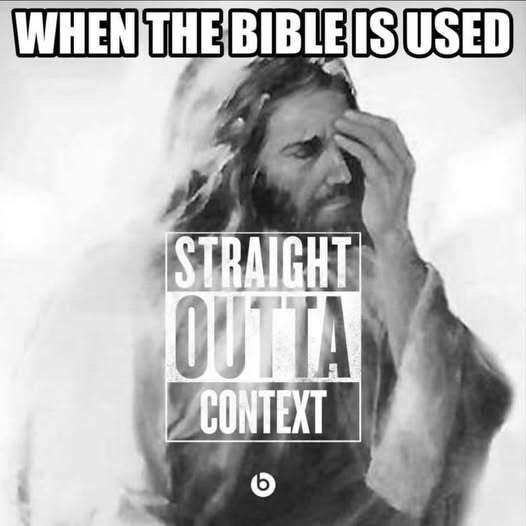
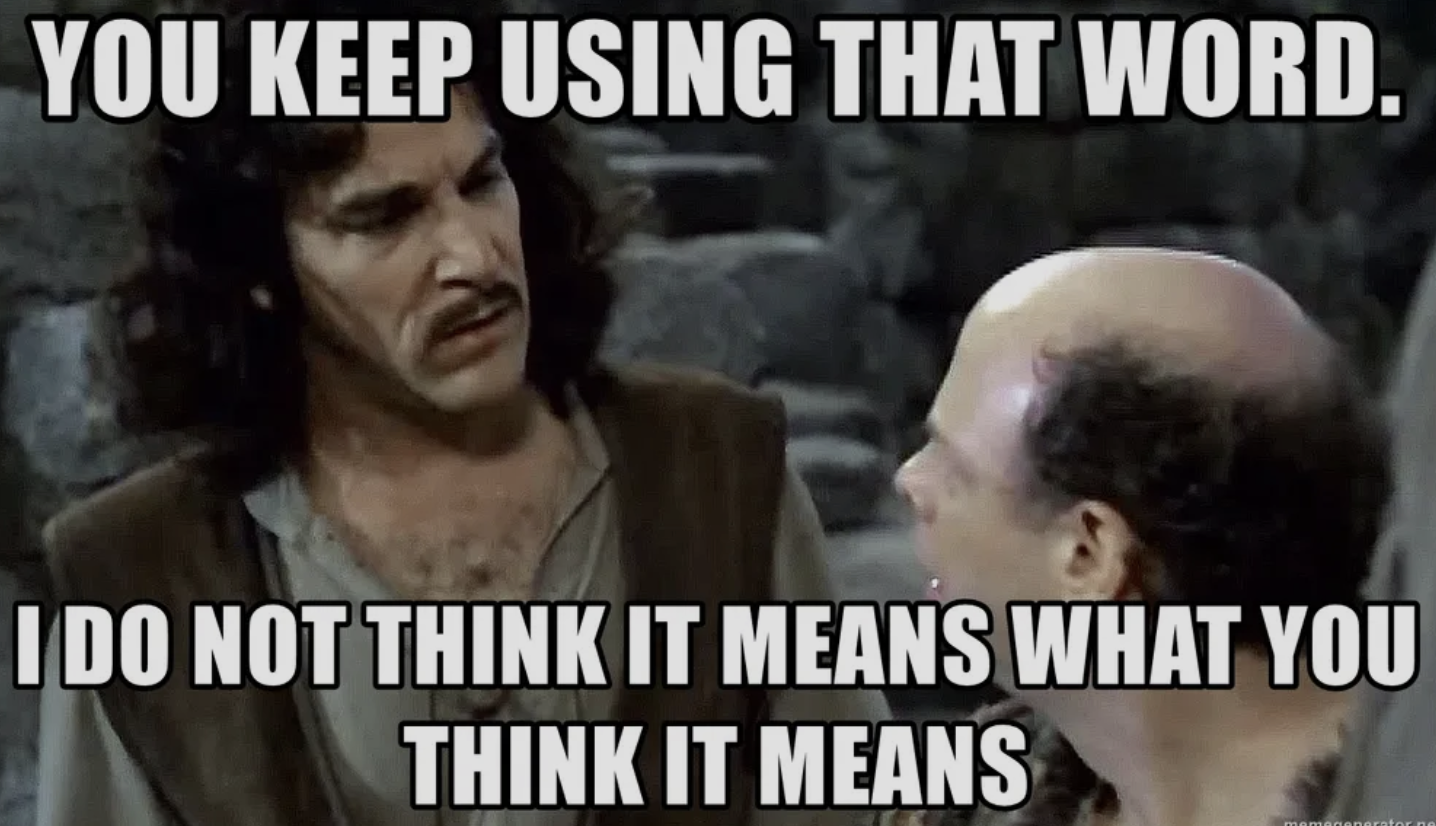
For this course, I hope to gain a new perspective that helps me understand the best ways to present the New Testament in my role as a pastor. I’m also interested in any updated scholarship or resources that are new to me since I completed seminary two decades ago! This meme cracks me up - and motivates me to understand more about what I'm sharing before I make big claims! (Also peep the ironic white Jesus here...also out of context?)
Hi, everyone. I’m Ching-Hsin Han, and I go by Steven. This is my first time taking a DSF Collective course for my CEUs. I am an ordained minister serving as a full-time pastor at First Christian Church of El Monte.
I grew up outside the States in a Christian family. I was trained at a relatively conservative theological school where biblical theology was emphasized more than systematic theology. Thus, in terms of the NT texts, I believe they are God's inspired word wrapped in a socio-economic culture, which I must unfold before forming strong opinions based on naïve assumptions. The NT text is like a life partner. You think you know her, but there is always more. The more time you spend with her, the deeper things emerge. Committing and engaging are the keys. Besides my mother tongue, I use the NRSVUE and NLT interchangeably.
I view myself as a scholarly pastor. I enjoy rigorous NT studies for the sake of practical ministry. Previously, I was taught to start with Greek exegesis and grammar, but it often led me to miss the forest for the trees. Now, I enjoy focusing more on the socio-cultural perspectives of the Greco-Roman empire. At the same time, I try to bridge the gap for modern readers, especially in the American immigrant context.
I would like to learn through the lens of NT studies, whether that involves new approaches, emphases, or historical facts. Though I know that the Bible can’t cover everything modern people are concerned about, I still expect to confidently grasp biblical principles and learn how to balance them with a solid academic foundation. Since the course is about leadership, I would love to rethink what spiritual leadership is about, how to distinguish it from business leadership, and how to navigate the gray areas in between.

The picture, not AI-generated, I uploaded was taken by the photographer Sam Rowley.
It took Rowley nearly a week down in the London Underground tunnels to capture it. I’m in a life stage where I’m kind of stuck, but meanwhile, I am waiting with hope to grasp something phenomenal and to see something beautiful in God’s hands.
Hi Steven- Nice to meet you in this course. Through this course I am learning what you described, about unfolding the culture and context to these scripture writings, to better understand the underlying message. Also, I am a small business owner, and like you, I would like to consider where my roles of "spiritual leadership" and "business leadership" overlap and how they also may differ. Thanks for sharing!
Hello! Some of you already know my story as we’ve been together a little bit now. I’m Erin Zavala, a layperson who attends First Christian Church of North Hollywood. I work as Development and Communications Manager for Disciples Seminary Foundation, Director of Communications, Marketing and Development for Higher Education and Leadership Ministries for the Christian Church (Disciples of Christ), and I’m on contract with the Southern California Nevada Conference of the UCC to do their communications. I work with a LOT of clergy! I’ve been a Disciple for over twenty years now and have just begun my journey into theological studies with this certificate program. I am unsure where it will lead me, but I’m excited to find out. Even if I find that I end up exactly where I am now but with more knowledge I will be happy.
The New Testament is where I’m most comfortable when it comes to the Bible. I don’t feel that I know it nearly as well as I want or should, but as I have moved through it over my lifetime, I enjoy that I learn new things about myself and the lessons as I read the text. The Bible for me has a way of living and changing on its own as I live and grow. I admit that I don’t always understand it because of the way it is written and I have to go back and re-read some things, and then apply the context of the times and translations as best as I can. Once I was aware that I needed to consider context while reading the Bible, everything changed for me. That wasn’t something that I was taught when I was a child and growing up Catholic.
I hope to gain more comfort with my knowledge of the text of the New Testament and hopefully, further my education after this month long course with some additional classes. I feel that the more time I spend with the Bible, the more helpful it will be for me to understand how to hear other people’s interpretations as well as misinterpretations. The way some people in this world are weaponizing the words of the Bible to further their needs is something I would like to feel more confident in combatting in while in conversation.
I look forward to our discussions and lessons!
Hi all,
My name is Annie Richardson and I’m a student in the DSF Certificate Program, “Pastoral Leadership in a Divided World.” I am not ordained, and not in pastoral ministry. This program is actually my first encounter with seminary. I serve as a lay leader at the Abundant Life Christian Church (DOC) in Los Angeles, founded October 9, 1983, and I am a charter member. I currently serve as the Chairperson of the Board of Directors and Congregation.
I often tell people that I’m a “New Testament” Christian. My reason, I tell them, is that I prefer Jesus’ yoke, rather than a yoke which requires me to be held to complex, legal requirements as a means for salvation. I say, “that’s too hard.”
I feel like it’s in the New Testament that I find that God’s grace and mercy, through Jesus, is available to me. I feel like the cloud by day and the pillar of fire by night were God’s grace and mercy offered only for the Israelites.
I love that the New Testament tells of Jesus’ life from the perspectives of those who walked with him in the flesh, were eyewitnesses to his miracles, and knew the scriptures that proved that he was the Messiah. I contrast this with those like me, who heard of him and believed; and now strive to abide in him and to know the purpose he has for me.
The truth is that I’ve never taken the opportunity to critically read the New Testament texts to compare the gospels and to look for what they mean in my life during this time. This course is my first opportunity and my first reason to do that.
I wasn’t sure how to classify my interpretation of New Testament text, so I had to do some research. At this stage in my learning journey, I think I can classify myself as interpreting the text through an understanding of the political and cultural atmosphere of the time in which it was written and the political and cultural atmosphere of the United States at this time. Comparing how poverty, oppression, and justice are addressed in those two eras.
What I hope to have gained by the end of this course is an increased understanding of the New Testament text, and the ability to discern or discover how these texts apply to my own life and how I might use these scriptures to help me serve others.
Where am I in my journey? I will be traveling this road for a long time because I have a long way to go.

www.ministrymagazine.org “The Spiritual Journey of Leadership”
First, my apologies for such a delayed response. The month of May included multiple challenges for me, but I have enjoyed approaching this material and now playing catch up on the responses.
My name is Maxwell Erwin, and I am a member and lay leader at First Christian Church in Chico, California. I am seeking both a deeper theological grounded education and also the skills that I need to be a more engaged and helpful lay person inside my church and my community at large.
Growing up, I have always spent much more time with the New Testament and the Gospels than I did with the Old Testament. I am very drawn to Jesus’ life and ministry, and I believe that it provides an example of how we may live our lives to be more in alignment with God’s will for us and our society. One of the things I’m learning throughout this entire program is just how our individual location (economic, social, political, geographic) influences the ways in which we read and interpret scripture, for example Zacharia’s interpretation of Matthew through an Indigenous lens. I personally tend to read the scripture through a lens of liberation, and I believe that God wants people to live free lives where they can become who they are meant to be. I am more convinced than ever that our diversity of thought is our strength in church spaces, and the more we can talk with one another about “why” we believe what we believe, the more we can form a mission-aligned coalition of Christians who want to address our world’s deep divisions and limitations.
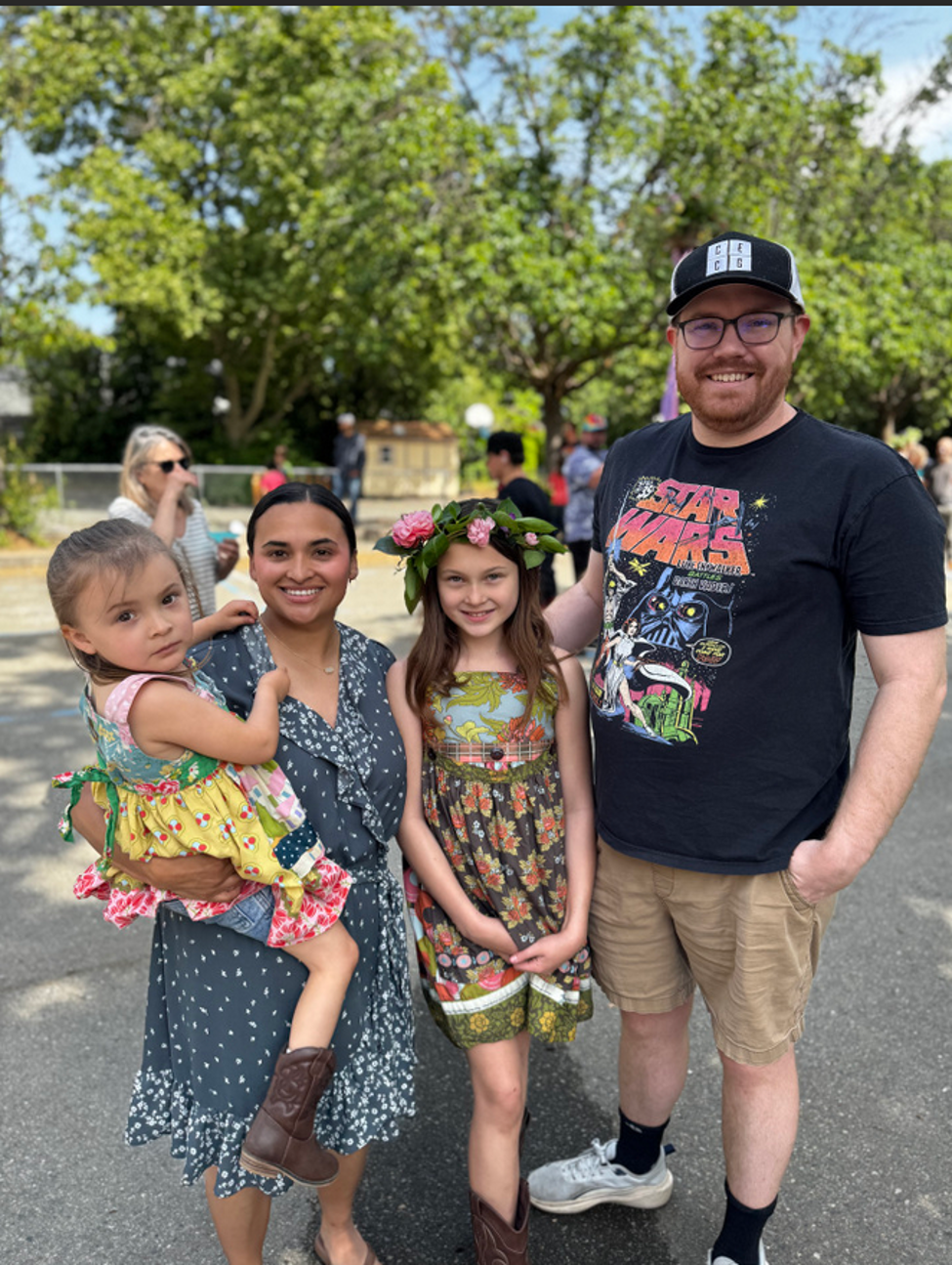
I bring you a picture of my family. It is because of them that I approach all these topics of faith with a critical eye, an open mind, and a determination to leave the next generation hopefully better than ours.