
S1 Assignment | Introduction to Rhetorical Use of Text | Reflective Question
January 7, 2026 5:29 PM
Reflect on a time when you passionately advocated for an idea or belief—consider how your personal experiences and cultural background shaped the way you interpreted that situation—and discuss how this relates to the encounter between Jesus and the Syrophoenician woman, particularly regarding the negotiation of boundaries of faith and inclusivity.
Discussion (26)
As a young adult I had a discussion with my father about the exclusiveness of Christianity. He was an intellectual and regularly read scholarly writings on faith. I was surprised to find that he still believed that Christianity was superior to other religions. I had been raised to believe that Christ was the one and only way. But in my encounters with a more diverse group of people in college, I had come to see Christianity as just one way to come to the Divine. Christianity just happened to be my faith because of where and to whom I was born. Other faiths were just as valid.
This was a long time ago. Many years passed before my father died and we never spoke about that topic again. I have to believe that he, like I, came to a more inclusive understanding of faith.
The story of Jesus encountering the Canaanite woman seems to highlight a time when even Jesus had a change of heart. He was taught a lesson by the Canaanite woman. She too was human. She too deserved grace. She too had faith in a God (or gods) that would hear her pleas for help. The fact that this story is included in the bible tells me that the writers wanted their readers to open to a more inclusive faith as well.
I learned in my Theological Thinking class that our perception of God or the Divine is based on many factors, including cultural context. Given your father’s cultural context, I wonder if you are still surprised, in retrospect, by his belief in an exclusive Christian faith? It appears that Jesus was speaking from his own cultural context when he told the Canaanite woman that "It is not right to take children’s bread and toss it to the dogs.” The woman was begging for Jesus to heal her daughter. From our contemporary context, the compassionate thing to do would be to heal the girl, but in the religious context of the day, healing was not something that was meant for the Canaanite woman and her daughter. It was the exclusive territory of “true believers.” And I wonder what brought about a change in your father’s beliefs. Do you know if the scholarly writing he read pushed against his understanding of Christianity?
Judy, what a thoughtful and honest reflection! I appreciate how you name the role of upbringing and later encounters in reshaping your understanding of faith. Your reading of the Syrophoenician woman insightfully captures the text's tension around boundaries and suggests that the Gospel itself invites readers to wrestle—sometimes uncomfortably—with questions of exclusivity, humility, and expanding visions of grace.
Katherine Whitney
When I was a parent of young children, I developed the passionate belief that my most important task is to love my child: to create a secure attachment, to understand their unique needs and to accept them as the small humans they were. I believe that they are inherently good and should not be shamed or led to believe that they are in any way intrinsically bad. My partner—who grew up in a patriarchal family in Iran and came to this country as a teenager—felt differently. Some of his actions (not all) were hurtful to our children, who are able to tell their stories now that they are young adults.
My belief was initially informed by my younger sister, who was getting her master’s in early childhood education just as my first child was born. I recognize that my belief comes out of a place of higher education and is informed by 20th-century psychology and living in San Francisco in a socioeconomic demographic where attachment parenting was the zeitgeist.
My situation doesn’t stand up well to that of Jesus and the Syrophoenician woman. I wasn’t able to make my case strongly enough to make my partner change his strongly held cultural customs and beliefs, as I interpret Jesus to have done in with the Syrophoenician woman. All I could do was parent in the way that was authentic to my beliefs and hope that my children’s inner constitutions would be strong as a result.
I'm so glad you were able to impart to your children regardless of the opposing views of your partner.
Hi Katherine,
I’m not sure Jesus changed his mind about the Syrophoenician women. Yes, he granted her request, but there’s nothing that indicates that he healed her daughter because he thought more highly of Syrophoenicians. You pose your position on child-rearing in Western terms and values. This is a viewpoint that many communities of color, in general, are hesitant to accept because it is perceived that the community’s cultural values will be left behind. So, a parent may choose to stop using corporal punishment to discipline their child. That doesn’t mean that the parent has had a turnabout in their views on the dynamics of power between parents and children.
Katherine, your reflection thoughtfully parallels the Gospel's tension between inherited convictions and lived encounters, especially how deeply embedded beliefs are often tested rather than overturned. Reading the Syrophoenician episode this way, the story may be less about Jesus' transformation and more about how faith presses against boundaries, exposing the limits of exclusivity and inviting readers themselves toward a wider horizon of belonging.
Amanda Weaver
I grew up in a conservative community that was not diverse. Conversations around race, gender, sexual orientation, immigration, etc. tended to reflect fearful, exclusionary, and sometimes downright hateful opinions. Moving away for college did wonders for my viewpoint, and studying instead of merely performing my faith expanded it further. My parents and I have come to an understanding that I am far more “liberal” than they are comfortable with, and that is going to make us all unhappy occasionally.
We have had countless conversations over the years, and I have vivid memories of the feeling of defeat when I was not able to change their minds about some topic or other (especially when I was younger and just knew that I was right). I’ve gotten more persuasive and able to present evidence over the years, but we still stand worlds apart on most of these kinds of topics. I get excited about the baby steps, but they are largely happy with their worldviews and do not see a reason to change them just because “the youth” think they know better.
Clearly, I do not have the skill of the Syrophoenician woman. It’s taken me years to do the tiniest bit of convincing, and the Syrophoenician woman was able to change Jesus’s mind in just a few sentences. This story has always reminded me of something I was told in a Bible study; the authors of the Bible were determined to tell the truth and they weren’t going to let the facts get in the way. The passage is too tidy and is nearly devoid of emotion. I imagine that the actual conversation was longer, messier, and more passionate as Jesus’s belief was challenged by someone who was not even supposed to be there.
Like me, the foundations of your faith came from your parents and community. Interesting what a change of scenery will do! I gained much clarity after moving to California.
Amanda, you capture beautifully the emotional weight of living between worlds—loving people whose convictions were formed in a different context while carrying the ache of being unable to move them very far. Your reading of the Syrophoenician woman is especially compelling in how it resists a "tidy" moral and instead imagines persuasion as slow, uneven, and costly, inviting readers to see the text less as a script for winning arguments and more as a space where contested boundaries are narrated and re-imagined.
M. Cross
Rhetorical Use of Text
EunHye Grace So
Lesson 1, Assignment 1
When my parents adopted my brother and me, my mother was in her mid-40’s and my father in his early 50’s. The foundations upon which I was raised was first, the tenants of the Bible and, ‘Honor your father and mother so that it may go well with you and that you may enjoy long life on the earth”. (Ephesians 6:1-4, Amp). Basically, do as I say without question. You don’t need to know why.
I was influenced by aged parents, the norms of the midwest and spiritual beliefs of friends and family and I saw things through those lenses. Even though I changed denominations, Catholic to protestant, with sometimes opposing tenets, there were still basic beliefs and commonalities subscribed to by all. And I stood firm in the way I understood scripture. I was firm in my foundations.
Black & White - Concrete - It Is What It Says - Don’t Question
But then, I moved to California in my early 30’s and worked as the office manager for my church. Because of the ministry’s ‘whosoever will let him come’ mission and vision, I was introduced to people from all different walks of life, ethnicities, and sexual orientations. Where before I was apt to disregard these people, I came to know, see, and understand the person, not the behavior. Because scripture excludes no one, neither can I. It has been the most freeing thing in my life.
Where before certain scripture was used to attack and condemn specific behaviors, I learned to read and study the Bible for myself and asking God for understanding.
I learned a liberating gospel. I saw the principles in action. The scriptures were the same but my interpretation and understanding of biblical principles was broadened. Instead of a straightforward, linear, and unbending view, I saw the love of God in HIs Word. It became less about avoiding sin and more about relationship with God.
Like the persistence of the Syrophoenician woman who pursued Jesus for her daughter’s healing, the limitations of the norms no longer applied. I began to pursue Jesus.
Mary Catherine, your reflection powerfully names the shift from inherited certainty to lived encounter, especially how relationship (not new texts!) reshaped the way you read Scripture and understood God's love. I also appreciated how you connected this to the Syrophoenician woman. Persistence, proximity, and seeing the person rather than the category become the means by which rigid boundaries give way to a more relational, liberating expression of faith.
In the fall and late winter of 2023, an interfaith group in the Bay Area began to advocate for the people of Palestine. Some had been fighting for Palestine as a matter of their faith and personal conviction for decades, and some of us were new, but we all knew that the Zionist entity’s framing of October 7th and their response was unjust.
In 2021, a number of my Buddhist friends, all members of our denomination of Jōdo Shinshū in the national organization of the Buddhist Churches of America (BCA) got into trouble with our bishop and president for challenging Zionist propaganda and uplifting the Palestinian struggle for liberation. “They have no idea what they’re talking about and really need to stay in their lane,” then BCA president Rick Stambul, staunch civil rights lawyer and Zionist responded at the time.
I recall in the late 2000’s when I was a graduate student at San Francisco State University, my worldview was drastically shifting after leaving church, living on my own, and letting go of my Christian Zionist and white nationalist upbringing. I’d attended a few informational sessions organized by Palestinian students and their allies, and I was equal parts shocked at the blatant lies of Zionism and at the same time not at all surprised, as I had been raised on a steady diet of propaganda throughout my childhood.
Coming back to winter of 2023, something in me snapped, and I joined the interfaith movement for Palestine, where several congregations raised the same banner on their buildings’ facades: “Love Demands Permanent Ceasefire Now!” in colors of the Palestinian flag with a white dove. My friends and I at the Berkeley Buddhist Temple wanted to raise the same banner in front of our temple, but after four months, a dozen committee meetings, and three heated board meetings, the best we could get was a modified banner: “Compassion Requires Permanent Ceasefire Now” in black and white with a dharmachakra, hung in the temple courtyard where passersby couldn’t see, a banner which mysteriously disappeared during our temple cleanup, but I quickly had replaced.
I was shocked to learn how so many in my sangha treasured harmony over justice, but we didn’t give up on trying to help our community understand what was happening, what had been happening for over a century, in Palestine. We organized intergenerational conversations about trauma, how the brutal incarceration of Japanese Americans during World War II left so many in our sangha afraid to take any sort of controversial “political” stance. We invited Palestinian teachers and healers to share their stories, made Palestinian food to share, and still, the ones who needed to hear the message we were trying to share the most, failed to attend our sessions. I gave dharma talks emphasizing the fundamental importance of liberation to all Buddhists, shared stories from sutras, teachers, and dharma masters, but the more I tried to tie support of Palestine and all colonized/oppressed peoples to our faith, the more the opposition dug their heels in—with no scriptural backing for their opinions to boot.
While a cornerstone of the Buddhadharma is Pratītyasamutpāda, lovingly translated as Interbeing by Ven. Thich Nhat Hanh, so many people in our community still see the genocide of Palestinians as a religious & political matter that doesn’t concern us. On the other hand, those of us who have advocated for Palestine have identified more and more likeminded people whose intergenerational trauma of fear had been forged into courage and resolve. Could these newfound friendships and the temple’s banner be the “crumbs from the master’s table” spoken of in our Biblical readings from this week?
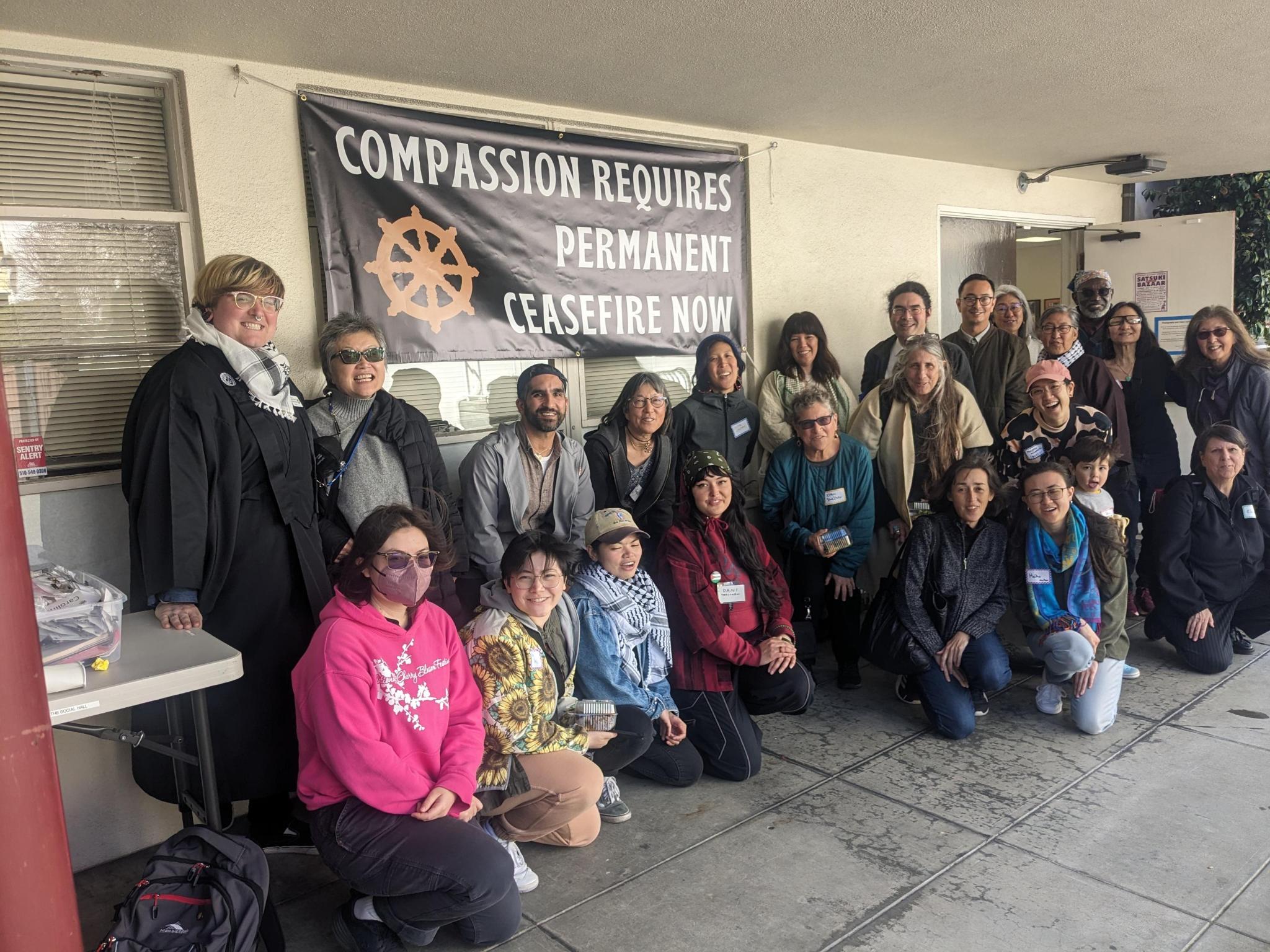
CJ, your reflection powerfully names both the cost and the persistence of faith-rooted advocacy, especially when institutional harmony is privileged over liberation and justice. Reading the Syrophoenician woman through this lens, the "crumbs" may indeed be found not in official approval or immediate transformation, but in the solidarity, courage, and interdependence forged among those who refuse to look away and continue to insist that compassion, and faith, cannot be confined to safe or invisible spaces.
Deborah Anderson
Church attendance was not a priority in my childhood, but my aunts and uncles made sure I went to Sunday School—and I loved it. Those early experiences planted something long before I had language for vocation. Years later, after a winding journey through my twenties and thirties, I decided to go to seminary, confident that God was calling me.
Eager for affirmation, I shared the news with my uncle, a Pentecostal Christian whose faith I respected. Instead of celebration, he offered a blunt judgment: divorced people—especially divorced women—had no place in ministry. What I expected to be a blessing became a boundary. Though shaken, I responded almost instinctively, “Well, if you can’t get them coming through the front door, you can get them coming through the back.” The conversation ended there.
In Mark 7, the Syrophoenician woman also crosses boundaries—gender, ethnicity, purity—by addressing Jesus directly and asking for healing. Jesus replies with unsettling language: the children must be fed before the dogs. Mark offers no clarification. Yet the woman does not retreat. She accepts the metaphor and reworks it: even the dogs receive crumbs. Her persistence becomes the turning point, and the healing follows.
The connection between these stories is structural. In both, faith approaches authority expecting mercy and meets refusal framed as faithfulness. Yet faith does not disappear. It persists, speaks, and finds another way in. Mark leaves the tension unresolved, forming disciples who learn to live faithfully without certainty. That, it seems to me, is good preparation for life.
Deborah, your reflection beautifully names how faith often emerges most clearly at the very moment it is denied institutional affirmation, and how persistence can become its own form of vocation. Reading Mark this way, you highlight how the text trains disciples not to resolve tension too quickly, but to inhabit it faithfully, trusting that grace may still come through the "back door."
At one point during my college career, I considered studying International Relations. That summer I won an internship on Capitol Hill. In total there were 1,000 Congress interns and less than 100 were Black. I worked for Congressman Ron Dellums. My cousin worked for Congressman John Lewis. As interns, we occupied the lowest institutional tier, responsible for attending daily hearings and writing reports
My cousin and I sought to gather all the Black interns to share strategies and build networks. Some refused, fearing the separatist label. Their concern was rational. When one possesses no power, visibility carries risk. My assessment differed. Isolated, we possessed nothing. Collectively, we might survive better. We organized gatherings and provided mutual assistance with required reports. Working on Capitol Hill that summer shifted my interest in politics. By summer's end, my interest in International Relations had dissolved.
The Syrophoenician woman in Mark's gospel negotiated from similar powerlessness. As a Gentile approaching a Jewish teacher, she possessed no legitimate claim on his attention.
Both encounters involved arguments from structural powerlessness. The woman challenged Jesus's conception of abundance. I argued that Black interns supporting one another did not diminish others. Both arguments contested the assumption that inclusion requires exclusion. Yet both accepted the fundamental framework positioning us at the bottom. The woman still identified as a dog. I still organized within a system designed to distribute minimal benefits.
The woman negotiated boundaries and won concessions within existing structures. I refused those boundaries and withdrew from the field entirely. The distinction matters. Her strategy achieved immediate relief. Mine rejected the terms of engagement altogether. Both challenged boundaries of faith and inclusivity as power structures, but only one remained to continue the negotiation.
Shiree, this is a sharp and illuminating comparison, especially in how you distinguish between negotiating within structures and refusing the terms of engagement altogether. By holding your story alongside the Syrophoenician woman, you help us see that Mark's text raises not only questions of inclusion, but also of strategy, when persistence within constrained systems is faithful, and when withdrawal itself becomes a form of critique.
Leonard Bailey
Rhetorical use of text
Reflective question - lesson 1
I remember this one time in junior college when I was on the student leadership board trying to push for more mental health resources specifically for Black students. We had seen too many of our peers dropping out, breaking down, or just quietly struggling in isolation. When I brought it up in a general meeting, it was brushed off—like we already had “resources for everyone.” But that was the thing: “for everyone” didn’t always mean it was safe or accessible for us.
So I pushed harder. I kept showing up. I emailed admin. I gathered stories. I made the case that culturally competent care wasn’t some special request—it was basic equity. Eventually, they listened. We got a therapist who specialized in supporting students of color and held a mental health town hall centering Black voices. It took persistence, and yeah, some pride-swallowing, but we got there.
That moment reminds me of the Syrophoenician woman in the Gospel. She knew what she needed—for her child—and she didn’t care that she was technically an outsider to Jesus’ “household.” She wasn’t disrespectful, but she also didn’t back down. She flipped his own metaphor on him: even dogs deserve crumbs. That hit me. She didn’t just ask—she challenged the boundary Jesus was working within. And Jesus changed. That’s wild.
What that says to me is that faith is not about being passive. It’s about showing up, even when you’re told you don’t belong. It’s about believing that grace can be bigger than tradition. Her story shows how advocacy—especially from the margins—can shift the center. And that gives me hope for the work I keep doing, too.
Leonard, your reflection powerfully connects lived advocacy to the Gospel story, especially in how persistence from the margins exposes the limits of "for everyone" language that overlooks real inequities. By reading the Syrophoenician woman as someone who refuses passivity and presses grace beyond inherited boundaries, you show how faith can be an active, courageous force that reshapes what the center is willing to see—and become.
There was an uncomfortable exchange between Jesus and a Syrophoenician woman. She approached Jesus with a request that he heal her demon-possessed daughter. Through a modern lens, the daughter most likely had mental illness or was experiencing seizures, but that is a conversation for another paper. As a Syrophoenician, the woman likely spoke to Jesus in Greek, a clear marker that she was a religious outsider. The Gospel of Matthew1 refers to her as a Canaanite, evoking an exclusion based on an historic rivalry from the Old Testament. The Gospel of Mark2, however, emphasizes the woman’s location, Tyre, and marks a religious exclusion. She lived in an area of Gentiles and was being excluded because she was a Gentile.
The response from Jesus was initially dismissive and insulting. He told her that it wasn’t right to give the food for children to dogs. This response from the meek and mild construction of the Jesus of my childhood is shocking. He not only refused to heal the ailing daughter, but he implied that they were dogs and not worthy of his time or attention. Her response was also interesting, given that she didn’t counter the insult. She responded that even dogs get crumbs from the table. She did not say that she was not worthy of the insult. She said that she merely wanted some crumbs from Jesus. With her response, Jesus healed the daughter.
The Gospel of Mark intentionally creates moments where insiders misunderstand something and outsiders correct the situation by a show of faith. Yet, this passage is shocking. It is also quite ambiguous. We never read that Jesus changed his opinion of Syrophoenicians or that he apologized for his insult. We also never see in this passage a demand for respect and inclusion, merely a non-confrontational request simply for crumbs. My own journey from rigid Pentecostalism to a radically inclusive theology has been filled with similar ambiguities and varying degrees of negotiating for inclusion for myself and for others.
I began my faith walk in the Church of God in Christ or COGIC. This denomination is pentecostal and has a literal interpretation of the King James Bible. COGIC members also believe that people are condemned to hell who do not accept Jesus as their personal savior and are filled with the Holy Spirit as evidenced by speaking in tongues. I took it as my mission as a young person to make sure people were not condemned, yet I was dismissive to anybody who didn’t believe the same way I did in the same way Jesus was dismissive by not answering the woman when she called out to him.
I remember trying to convert a friend who was like a sister to me. I told her what I thought was the one true revelation of God, hoping she would accept it and be saved. My friend told me she was agnostic and refused to convert to my beliefs. The moment she left my room, I fell to my knees, and I cried because I didn’t want her to be lost. My understanding and scripture knowledge at the time caused me to be hurt over this because I thought she was going to hell. I couldn’t understand why my friend wouldn’t accept what I thought was the truth, but as Professor So stated in her lecture, “each moment of doubt is a step toward deeper knowledge.”3 This knowledge didn’t occur overnight, but through small experiences, step by step until I came to my current understanding.
A huge step forward in my deeper knowledge occurred when I was 23 and joined a group of young people who prayed in a friend’s home every Wednesday. We were all Christians, but very different. Some were Pentecostal. Others were Baptist. Our group contained people of various ethnicities and nationalities. So in this mix people, we had differing theologies. These differences led to arguments, at times, but remained friends. My best friend was biracial, African-American and Samoan. It was not unusual for people in her Samoan family to see ghosts. She came to me for help. She had become a Christian, yet continued seeing ghosts and was troubled by that. I was able to set aside my beliefs to listen to and support her. I studied her Samoan heritage to better understand her. We remained friends until her untimely death from COVID a few years ago.
Through conversations with my connections in the prayer group, I came to understand that there was nothing wrong with being gay and nothing wrong with all the differences we shared. I came to accept my own bisexuality and an expanded theology. I know my worth and I know that God wants more for me than crumbs from the table. The example from the Syrophoenician woman provides ambiguity, but it is not a weakness of this scriptural passage.4 It leaves room in the Scripture for interpretation. I believe it is an example of how faith operates through disruption. It wasn’t until she spoke back to Jesus that she got her needs met. And it wasn’t until I was able to “speak back” to my own beliefs, that I was able to fully embrace myself and others. Through the example of this woman in Scripture, I find that my faith walk is an ever-expanding journey.
End Notes
- Matthew 15: 21-28 KJV
- Mark 7:24-30 KJV
- Professor EunHye Grace So, lecture, “Rhetorical Lecture, Class 1,” Pacific School of Religion, no date specified.
- Michael Ahearne-Kroll, “Audience Inclusion and Exclusion as Rhetorical Technique in Mark,” Journal for the Study of the New Testament 32, no. 3 (2010).
Clark Kellogg
Theological Thinking
Prof. EunHye Grace So
L1A1, February 12, 2026
This invitation for reflection frames in my experiences of last week while teaching design thinking to undergraduate students in Japan. Of the 24 students, 20 are Japanese and four are from China. I am hopelessly American and from California, where design and entrepreneurship are well-established in the culture and in our universities and colleges.
I have taught something like a dozen times in Japan, China, and South Korea. Culturally, risk-taking and innovation are challenging. Conformity and coloring within the lines are, in general, cultural norms. My purposefully informal teaching style - being a “guide on the side” instead of a “sage on the stage” - is, at first, jarring to these students and pushes them outside their comfort zone. While this is by design, I know it raises more questions than answers and challenges the one-right-answer tradition of university lectures.
I relate these experiences for both the students and me to the interaction of Jesus and the Syrophoenician woman in that at first the interaction doesn’t actually make sense. Instead, it raises questions of meaning, intent, and understanding. My teaching style is strange, unexpected, and laden with questions.
This story, like the Scripture story, has a happy, if unorthodox, ending. By the end of our class, the students have figured out how to make sense of the content and the style. They have lots of questions and have developed courage to ask them. Also, we practice being comfortable with ambiguity and big dose of paradoxos.
Clark Kellogg
Rhetorical Uses of Text
Prof. Dr. EunHye Grace So
L4A1, February 25, 2026
Reflect on how your own social location—considering factors such as cultural background, economic status, and personal experiences—has influenced your interpretation of a familiar Biblical passage. What new insights or challenges arise when you compare your perspective to more traditional, mainstream interpretations?
I’ve attended two churches in my life: Riverside Church in New York City and Epworth United Methodist Church in Berkeley. Neither of these churches are exactly white Protestant churches of privileged elites, but both come close. Each creates space for different versions of Jesus and even God. But these are intellectual constructs, not lived or embodied ones.
I come from a Western, educated, white Protestant world. A world that values clarity, coherence, and right belief. When I read biblical texts, I search for theological meaning and personal application. What does this teach? What should I believe? How should I live? The story of Jesus and the Canaanite woman is a good example. I read it as a lesson in persistence and courage. She models bold faith. Jesus rewards it. The moral seemed clear and uplifting.
I know my social location shaped that reading. The trajectory of my life has taken me from relative poverty and high school-educated parents, to being economically secure and highly educated. That is an embodied journey that has shown me views other than undiluted “Wealthy WASPy.” Today, I live with educational privilege, economic stability, and institutional authority. I read from the inside, not the edge. I identify—almost unconsciously—with the disciples and with Jesus. I stand near the center of the story. Even when I admire the outsider, I do so from the inside.
Reading postcolonial and liberation readings, and listening to lectures by Dr. So and other PSR professors, the dynamics of power in my own social location have moved from tacit awareness to explicit understanding.
From this point of view—aware of systems, leadership, and the difference between reaction and response—I notice, for example, a different version the story of Canaanite woman. It’s not just a test of faith but an encounter that exposes assumptions. It’s a moment where power is challenged and where openness creates transformation.
That interpretation has insight and an invitation. The insight is that Scripture is not static. It is alive with relational dynamism. It invites humility, even for those at the center. The invitation is for faithfulness to include changing one’s mind; to revise one’s stance when confronted with the truth of those from the margins.
This work unsettles my theological reflexes – as weak as they may be. I like these new questions:
Is the text providing a moral takeaway or showing oppressive power exposed?
Is the text burnishing individual faith, or framing in communal systems?
Can the text be universally applied to everyone, or is it just one perspective?
Acknowledging social location doesn’t diminished Scripture for me. It deepens it. The text has more relevance because it no longer feels like rote recitation. It feels alive and spikey. I’m reading from somewhere – and not everywhere.
A time I remember strongly advocating for something I believed in was when I was building out spaces through Summons Productions and had to define who gets access to perform and be platformed. I found myself pushing for a standard—not just anyone on a lineup, but artists who were prepared, intentional, and aligned with the level of experience I was trying to create.
My perspective in that moment was shaped by my personal experience as a creator and organizer. I understand what it takes to build something from the ground up, and that made me protective of the space. Culturally, coming from environments where opportunities are often limited or undervalued, I’ve learned to treat platforms as something that must be structured and earned, not casually given. That influenced how I interpreted fairness—I saw structure as necessary, not exclusionary.
At the same time, that moment also revealed a tension. In setting boundaries, I had to wrestle with whether I was creating standards for growth or unintentionally limiting access for people who were still developing.
This connects closely to the encounter between the Christ and the Syrophoenician woman . In that story, there is an initial boundary—who the message and healing is “for.” The woman challenges that boundary, and through that interaction, something expands. The moment is not just about denial or acceptance, but about negotiation—about what faith, access, and inclusion really look like in practice.
What stands out to me is that the boundary was not the end of the story. It became a point of engagement. The woman’s persistence and clarity forced a response that ultimately widened access.
Rhetorical Use of Text - Week 1 - Reflective Question - Ogundipe
Assignment | Reflective Question
Reflect on a time when you passionately advocated for an idea or belief—consider how your personal experiences and cultural background shaped the way you interpreted that situation—and discuss how this relates to the encounter between Jesus and the Syrophoenician woman, particularly regarding the negotiation of boundaries of faith and inclusivity.
One instance of a time where I passionately advocated for an idea or belief that was very much so shaped by my personal experiences and cultural background involves the evolution of my perspective on gun rights. I grew up in the metro-Atlanta area, a very urban part of the country. Growing up there the usage of guns was usually a negative thing, having had friends that were the victims of gun violence, I was very much so against the right to bear arms, because from my perspective and experiences the presence of guns marked a lack of safety and the possibility of someone dying.
This changed after I moved to Bismarck, ND, a state and city that I never thought I would move to. In Bismarck there are many people that own guns and there are many people that hunt. In fact many people buy negligible amounts of meat from the grocery store because much of the meat that families consume comes from hunting. In fact, it gets so cold in Bismarck in the winter time that sometimes people hunt, clean the meat, wrap it up, and put it under the back porch (it is so cold in the winter time that the outdoors can serve as a freezer.
Though I was around a decent amount of guns in North Dakota, the rate of murders and assaults by firearm are quite low. Much of the gun use in North Dakota, a very rural state, is used for hunting. I was able to understand how gun ownership might make sense in some contexts.
The disciples judged the Syrophoenician woman because they were looking at things from a particular point of view, but as Jesus engaged the woman a new perspective of who she was, and even more importantly who they were, emerged. Being open to being renewed is such a vital part of spiritual life.